Thursday, February 19, 2009

December 2006 (podcast)

Color Mixing Secrets
The Glooming
Michelangelo at the Coffee Shop
Lord of the Flies
The Color of Color
An Untoward Dalliance
By the Light of the Moon
Staring so Hard You Can't See
The Temperature of a Painting
Perpetuating a Might Have Been
A Slow Slide Sideways
Small Heads
Painting Seasons
Head in the Clouds
Sparking Psyche
From Antiquity to Antique
Loosee Leftee, Tightee Rightee
One Thing in Life is Free

Thursday, January 15, 2009

November 2006 (podcast)

Oh Sienna
Phtalo Blue and Impuissance
Extra Fresh
Hey, That's My View
Standing in Front of a Painting
Still Life Elements
Morning Light
Painting with Two Colors
Pallid and Pretty
Talented Eye
Heat in the Firehouse
Eye Contact
Center of the Universe
Cape Cod Idyll
Rose Colored Glasses
Keen Sense of the Obvious
Camera Obscura: Light in a Dark Room
Turkey Day
Complexity of Quiet
John Singer Sargent's Palette
Final Rigging
Baby Laps
Fog Induced

Wednesday, December 31, 2008

October 2006 (podcast)

Welcome
Opening Doors, Outdoors
Traffic Obstacle
Is Somebody Trying to Tell Me Something?
Channeling Angela
How many dabs is a man?
Frodo's Pergola
Roses and a Stone Wall
Taste in Gnats
Plein Air Appurtenances
Look, I'm an Airplane. Wheeee!
Pushing and Pulling
Scribbling on the Tabula Rasa
The Sound of Painting
Diffusion and Halationn
Audience of One
Ferry to the Vineyard
Starting Trouble
A Knife, A Face and a Bit of Color
Eye Candy
Tea for Three

Subscribing to Podcasts

These podcasts that I'm adding are audio versions of journal entries starting with October 2006. To subscribe, click on the "subscribe" link at the right and choose your reader. If you don't have a reader, Itunes is free and easy to use. Download the software at Apple and then come back and subscribe through this journal. If you have Itunes already, just go to the Itunes store and search for Doug Rugh and subscribe that way. As new entries are posted to this journal, audio files will then automatically appear in Itunes or your reader.

Thanks for leaving comments at Itunes.

- Doug Rugh

Wednesday, November 26, 2008

Osborn & Rugh Gallery


-Doug Rugh

Sunday, November 09, 2008

Blink and the World Changes

Oil PaintingStudio/Gallery

www.OsbornAndRughGallery.com


I'm fortunate that I have to set my alarm every day. One of my first jobs was drafting for a civil engineering firm and at 5 PM every day, if you happened to stay late, you could look across the rows of empty desks -- the door swung shut only once. We arrived at 8 AM while the head draftsman arrived at 8:10 (his knowledge of drafting iconography made him indispensable). He took the newspaper into the bathroom at 11:30 and stayed until lunch. He talked often on the phone to his wife of many years in sweet hushed tones (his desk was behind mine) and had his satchel packed by 4:45.

My job now is different. I have to set my cell phone alarm so I'll know when to put down my brushes even though I'm never finished when it's time to leave. On those rare occasions when I'm checking the clock to see what time it is, I know I'm on the wrong track with my painting. One thing I've learned as an artist is that if I'm not inspired I'm wasting paint (or priming canvases the sloooow way).

Two months ago, I was sitting at my easel just as I do now, but the light has changed. The studio has also changed and my commute is longer. I was perfectly content and the normalcy of the routine demanded innovation -- a plus -- but we got the call about new studio/gallery space in Falmouth and when we saw the windows we had no choice. So yadda yadda yadda (painting with big brushes, demolition -- thanks Damon, electrician and lighting -- thanks Dave, signage -- thanks Mike, carpet splicing -- oh knees!, dump run -- thanks Tom and Tony, borrowed van -- thanks Molly, alarm, phone, insurance, web site -- click click click) and two months later I'm back at the easel dabbing with familiar brushes. Shades of Vijnana Baihriva (for those who have time to delve into ancient texts.)

The first time I walked in our finished new studio space an image of art school popped in my head: how we used to envy the grad students in the fine art department and their assigned cubicle with a window at one end and an industrial pipe easel slightly askew in the middle of the room holding a large canvas. There were splatters all over the walls and floors. The splatters were important then. That was the dream, having your own space to just paint for hours and I walk into our airy new space with the large windows on both sides and the rugs and the coffee maker in the back -- even better than grad school! That's how real life should be.

-Doug Rugh

Friday, October 10, 2008

Our New Studio/Gallery Space

Art Gallery


My wife Hillary (www.HillaryOsborn.com) and I have just opened our new gallery/working studio in Falmouth, MA. Please come and visit!


More info at: www.OsbornAndRughGallery.com


-Doug Rugh

Friday, August 01, 2008

Documentary Short

Here is a short film by Kristen Alexander (www.MiddleWayMedia.com) that recently screened at the Woods Hole Film Festival:


-Doug Rugh

Monday, May 05, 2008

Leonardo and Rembrandt Stunned

Oil Painting View a larger image. Nobska in the Fog, 16" x 24" - oil/canvas
View a satellite map of the location.

Sorry I haven't posted in a while but I've traded some time with the music muse, putting aside one linear activity to make room for another: just letters for notes.

My friend Bill, an abstract and colorful painter who appreciates the representational (and hence an anomaly), visits on a regular basis and always leaves me thinking and asked, "What if Da Vinci and Rembrandt came into the studio? What would they think?"

I like the exercise of seeing through the eyes of these early mentors of mine and it gave me great pleasure to realize that the masters would be in awe of the work around them. And I don't mean just the art in my studio but any paintings that are a product of the minds of any of our contemporaries, no matter how humble. We are blind to our culture and in the fine arts, especially with our reverence for past masters, forget that progress is forward moving. Museums are filled with work of experimental minds of their time that have found and communicate insights that have nudged forward the state of the art. Displays of virtuosity don't, in themselves, make it to that historical archive.

We have all suckled from the masters who have laid the groundwork and it has enriched our eye. But Da Vinci and Rembrandt lack what we have experienced: Sargent's all-descriptive (and all-deceptive) strokes; Van Gogh's rhythmic marks; Thiebaud's penumbras; Innes's mood; Eakins' photo-copying; Irving Penn's cropping; Wyeth's "reportage"; Shiele's lyricism and brain; Jenny Saville's flesh; Odd Nerdrum's stutter and on and on. Not that our masters are any worse for not having seen it -- we are glad they were specialists -- but as visual artists they would have had a field day visiting with even the less gifted of us. An art therapist will tell you that can't put a simple mark to paper without revealing something about yourself and we are the masters' wise old friends. Even our amateurs are not as limited as they were. Digital photography, fluorescent tube paint and Saatchi's picks have thrown the doors wide open (or so we believe! -- let's revisit in 20 years.)

Describing a UFO visitation is impossible because the details of the event lay beyond personal experience. And, similarly, the brilliance of the pigments, the extravagant paint use (Rembrandt might be happy to see the fruits of his own experiments) and image cropping are unlike any they've seen before. Subject matter and sense of reality speak of an entirely alien subjectivity. As Dr. Seuss said, "All the places we'll go!" Leonardo would see landscapes that are not just afterthoughts fitted into the background but are themselves the main thing ("And the point is...?"). The materials and outfitting of the studio alone would be mind-blowing: the various lights, the ipod and its voices and pulses, french easels and pochade boxes, artificial flowers and framing hardware, printed postcards and art books, the cell phone and its occasional musical performance. Don't reveal the laptop just yet -- better to break them in slowly. Although...hospitality insists that you do nuke them a cup of coffee (if they'll drink it.)

Go ahead: picture Leonardo and Da Vinci sitting in the corner of your studio unblinking. The art world's version of shock and awe.

-Doug Rugh

Sunday, November 25, 2007

A Morning Chasing Light (It Got Away)
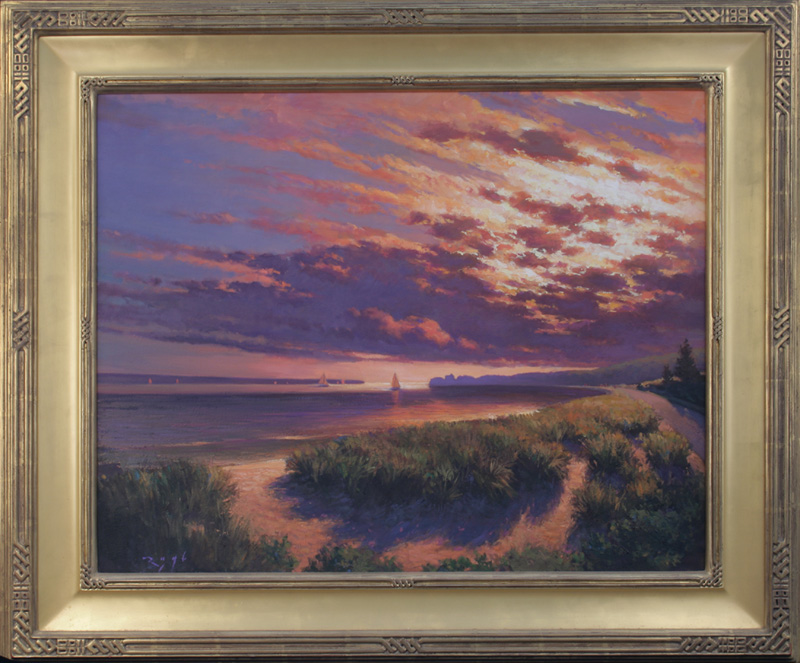
Oil Painting View a larger image. Bike Path Towards Nobska, 24" x 30" - oil/canvas
View a satellite map of the location.

As I do each morning, I peeked in Hillary's studio to view yesterday's progress and spotted the bright yellow of fresh carnations on the corner table in a vase trailing lemons and tangerines. On the opposite wall was her composition as only she could do it. Artists have a history of consuming their still lifes just before they sour so I had no qualms about, at a minimum, recycling the still life as a subject of my own. Of course, even if I cropped as she did or sat down at her easel, left as perfectly in position as a historical diorama, I wouldn't be able to avoid leaving my own distinguishing imprint. Some paint to find themselves, others to lose themselves and while painting like mentors has value for students, if the picture looks too familiar it's just not fun enough.

When I first sat down the static flash of sunlight hitting the side wall bounced off frames and fluoresced the petals and rinds poking into the beam. Chasing the light while negotiating edges with the tip of my brush, I watched it moving back toward the window and slip out. What was left to paint was the remaining cool grays (not that there's anything wrong with that.) But when I did, all was lost and I scraped down my palette. That's when the oft-repeated maxim entered (curses! curses!) my head: It's knowing when to stop that matters. Alas, pictures need to be finished but life depends upon the chase.

-Doug Rugh

Monday, October 29, 2007

Other Eyes

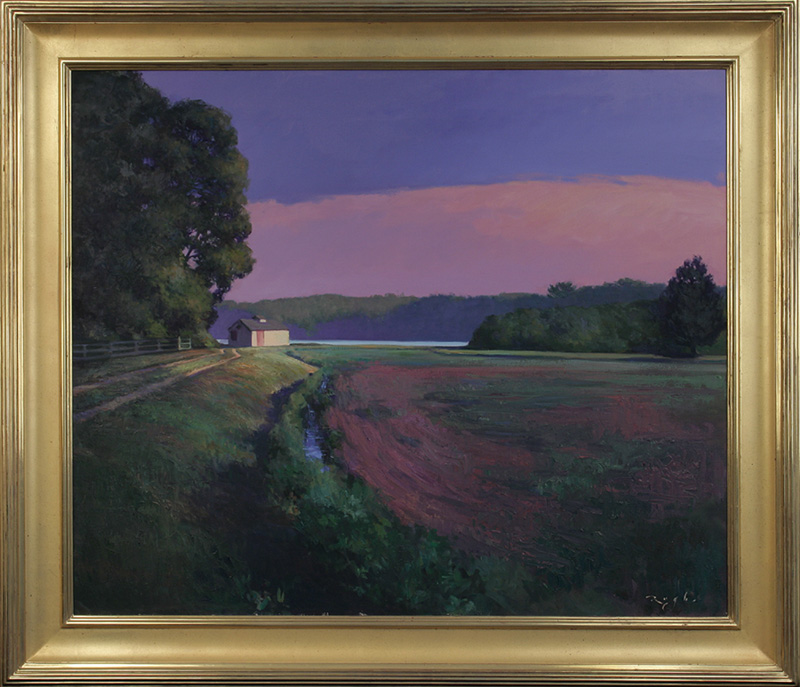
Oil Painting View a larger image. Cranberry Bog at Dusk, 30" x 36" - oil/canvas

View the painting location on a satellite map.

Unilateral Synchronicity
I'm always surprised that the paintings I'm most excited about are not necessarily the ones others have found something in. You walk into someones house and you see them standing in front of the paintings on their walls and they're wearing those same colors. "Don't you just love the colors?" she says and you do. For just a moment. And then you notice that the paintings are all a little cock-eyed and that your host is looking at you...a little sideways too. You're both in sync. Just not with each other unless you're seeing through their eyes.

Maybe having a good day is when circumstance parades all our colors by us one after the other and everything we come across is skewed at our individual angle: the spoon in the teal bowl, the rear-view mirror, the pencil on the blue table. And when it's your day you get to decide how the world looks and we're all wearing olive and orange stripes and everybody talks just one tick louder on the dial. And then I wake up and it's like walking uphill all day long and I realize, Hey, it's not my day it's yours!

That's why I like to hear people talk about the paintings that inspire them because if I couldn't see it before, now I can.

-Doug Rugh

Wednesday, July 11, 2007

Capturing an Audience

Oil PaintingStoney Beach Studies
View a satellite map of the location.

A few days ago I was on Stoney Beach in Woods Hole late in the afternoon attempting to paint some of the people on the beach. I didn't get very far but it was worth it. The gestures and poses were perfect, if only for moments. The children played just as I did thirty-some years ago; building dams around the shower to collect run-off, laying towels among the rocks to create enclaves and jumping off Paradise Rock into the dark waters of the deep cold hole on one side (there may be lobsters in there.) I do a double-take when I look at these children of my contemporaries, some the spitting image these many years later emphasizing the cyclical nature of a family beach.

It wasn't long before a crowd of kids was around me -- "He's trying to paint that way!" -- but mostly in front of me. I told them that I just started and if they came back in an hour there would be more to see. A few minutes later they started trickling back. I don't mind an audience (though I don't look for one) but these were my models and I'd prefer them out in position. A little later a girl came up to me in a rare quiet moment and said, "If I sit out there will you paint me?" And I thought, Of course! this is the way to handle it, and so I painted her on the rock at lower left in about five minutes and then the next three in a row that came up to me. I asked the girl under the umbrella in the towel to go back and pose and she was happy to do it.

It's very hard to paint moving people on the beach but it's so much a part of the Cape Cod experience that it's surprising artists here haven't found a way to do it. There may be a maxim: the harder it is to do the more it's worth in the end because in painting in the midst of life each little brush stroke captures so much about the person.

-Doug Rugh

Tuesday, July 03, 2007

Tickle Imagination Paintings

Oil Painting View a larger image. Eel Pond, Woods Hole, 9" x 12" - oil/panel
View a satellite map of the location.

I enjoy reading the Internet search strings that lead people to this journal. Most people who have web sites can see limited imformation about the visitors to their sites. If one arrives at the site by clicking on a link, at a search engine or another site, that search becomes visible as part of its' site statistics. Often a country of origin is visible but readers should not worry that any personal information beyond that (or screen name or email) is available because as far as I can tell it's not. Here are some of the search strings that I found amusing (And make me wonder, Who are these people and what are they really looking for?):

ego massage is a pleasant pastime
awareness of the air by cavemen
single +likes painting
paintings=looking out of window
oil paint tube, undo cap
fairy houses squirrel island
ducks as omens in indian mythology
lights in the sky from magnetism
painting of man with clouds for head
gluing things on oil paintings
oil expands muscle
"the depressionists"
To know somebody which worth the oil color painting hand.
trying to put vellum paper behind the panes of antique window frame
Tickle imagination paintings.
summer journal props
the glooming of trouble
oil painting signature disappears under black light
On May 19, 07 two people, one in Saudi Arabia and the other in
Mexico, typed "sleeping daughter" into Google and were led to this
journal.
"paid attention to the choice"
amoeba shape pergola
en plein air at night
journal effect layout office to mood works
The Imagined Studios of Rembrandt and Vermeer
paint color for dark hallway with limited lighting
dawn of caveman time
dark gloom
palette knife paintings hermit house
left \ right brained babies and their relation with colors
fishtail paintings
mirrors reflect orange sunlight movie
can i see same example how attraction flyer in orange colour?
odd nerdrum student application
infants skin pale in color when sleeping
just undo it

-Doug Rugh

Wednesday, June 13, 2007

Hidden Corner at Nobska Beach
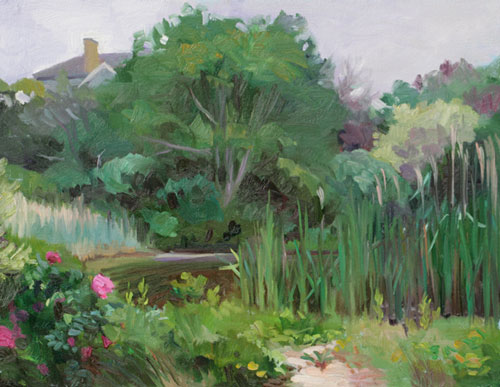

Hidden Corner, 11" x 14" - oil/canvas

View a satellite map of the location.

Yesterday fits of light rain were inevitable but I always get excited about stormy weather (if you don't: see Winslow Homer) as long as my palette doesn't get too wet and turn my oils into emulsions. The overcast skies, tent-lighting to photographers, bring out the intensity of colors and I've been waiting for a chance to paint the pink rosa ragosa flowers that are out early in the summer.

There is a pond out in the open in Woods Hole that goes unnoticed because it lies parallel to Nobska Beach. And like the pond, I was also upstaged by the view of the Sound as the few people who pulled up to the parking area didn't notice me painting a few feet away on the wrong side of the street. Wherever the Magician directs your attention look the other way or you will miss the trick. And so in the corner of this pond I found my sand flowers against a tapestry of many-hued greens. And whoever says about landscape painting, "Argh! Green green green!" is like the person whispering in your ear that there are mirrors involved when this time it really is magic.

I was careful to sit far enough away from the poison ivy so the wind wouldn't brush the plant against my back if I leaned back for a head-tilt but placed my french easel right in the stuff because you just can't paint outdoors on a canvas unless it's back lit. Half-way into the painting something scurried across the path under my stool, probably a chipmunk or a mouse, and I wondered how long he had been watching before he made a break for it or whether he didn't notice me at all as sometimes happens when you're sitting still for periods of time outdoors.

Then I remembered that a family friend had recently become seriously ill from a minuscule deer tick's bite and only hundreds of yards away from this very spot where I sit exposed and I realized that, yes, I too have a little itch in my sock. And another on the back of my neck. And it reminded me of the time in my portrait painting group when I noticed (during the break) that I had the bull's eye rash on my knee, the tell-tale sign of the dreaded Lyme's disease. The mark inspired much concern from my fellow painters until we resumed the pose and I realized the red spot was the result of the pressure of a non-toxic crossed leg. But eventually the mind stops wandering even if the wind doesn't and the hours quickly pass.

-Doug Rugh

Monday, June 04, 2007

Edward Hopper

Oil Painting Exhibition site. Hotel Room, 60" x 65" - by Edward Hopper

Peter Schjeldahl, a reviewer for The New Yorker, is one of the few art critics that I enjoy reading and always offers insights. In the May 21st issue he says so aptly about Edward Hopper that he bets everything on composition so that seeing the work in person doesn't add anything to the experience. I wouldn't have made the trip to see the paintings at the Museum of Fine Arts in Boston but by circumstance found myself walking quickly through the exhibit. I can't look at a handful of the works (my fault I know) because I can't get past the clumsiness of some of the figures (adding, of course, to his powerful sense of isolation), but I was surprised to find two aspects that took the paintings to a new level of enjoyment for me: surface and scale.

I've always loved dark darks ever since I was student at the Schuler School of Fine Arts, an atelier inspired studio, when I looked down at a pile of Prussian blue pigment that I had just poured out on to the marble one morning to mull with oil and under the natural light of the skylight it was as if I was looking into a black hole. No light bounced off the particles and the softness of the powder and it's deep color made it impossible to see any form. Once you've seen the void you're lost: you'll wish away clarity and Hopper puts black where he means vague. The variations in surface between lost areas and visible texture, between brushed thin paint and scumbled opaque paint is just enough to make the canvas push into three-dimensional life ahead of it's two-dimensional facsimile.

I've been working on large paintings in my studio all winter. The scale is an indulgence that pulls the viewer into the composition -- bigger demands more even if it is just color or cotton. I stopped in front of the large open Hotel Room (image above), a painting I had seen many times before as a little picture in books, and stood motionless along with others next to this woman on her bed.

-Doug Rugh

Monday, May 28, 2007

Taking the Fork in the Road

Oil PaintingStudio paintings in progress.

Lately I've been playing around with spots of pure broken color and how a little dab stains a whole area. (Most of this new work from the Winter and Spring hasn't yet been uploaded.) I've also been introducing saturated color as a way to emphasize to the viewer what it is that I'm excited about. Taking an intuitive rather than naturalist's approach. Because if we're intrigued by the way a tree's shadow side becomes blue when lit from behind by the sky and don't make the effect obvious, instead of seeing through the artist's eyes the viewer will just see another tree against another sky and turn away stifling a yawn. Plus I like to push the limits of pigment, granules which are so meager against life.

So naturally I was intrigued by a friend's painting at a portrait session in which he had used most of the same high chroma colors but pulled off a mud-head using the grays from the center of the color wheel. The panel could have been painted with two pigments harvested straight from the ground. I'm in Paris and he's never left the farm. I had been spending time on the periphery dazzled by the bright lights and I come back and he's just sitting under the tree with Ferdinand smelling the flowers.

-Doug Rugh

Sunday, May 13, 2007

Flying at Night

Oil Painting View a larger image. Inner Harbor, 9" x 12" - oil/panel

An artist can't put a mark on canvas without it saying something about its' maker and viewers can't look at an oil painting without seeing reflections of themselves. It is surprising, then, that an inspired painter breeds an inspired audience. We live in parallel but separate universes that overlap briefly for peak experiences and the challenge for artists and connoisseurs is simply to enjoy oneself while in the company of art. This is what I'm after:

When I was a kid I lived on my bike in our little summer village of Woods Hole. I knew the quickest routes through parking lots and down what seemed like a steep gorge in the woods risking wipe out rather than slow down for a corner. Speed heightened the senses and the instincts. Years of near misses with stuff flying towards me built confidence that I could maneuver safely at a moment's notice. And I always did. A bike travels through space in three dimensions. It's a rolling hinge that leans like a top as it turns and avoiding obstacles is less about a line from point A to point B and more about the rhythm of the handlebars pumping from side to side counter to the pedals. It's a dance where you place the beats in empty spaces. I felt in total control and would shift at the last minute to avoid a parked car or fishtail into sand blown up on the roads to smooth the turn or just for the fun of it. If I went around the Eel Pond up by the school house I could build up enough speed coming down the hill with hands on my knees that I was around the corner and sailing down Millfield in seconds. It was a time when nobody locked their bikes and you knew where your friends were by the piles of them dropped around town.

When I was older I'd sneak out at night and trace the same routes that I knew so well under black skies with the added challenge of not being able to see. The stakes were greater -- remembering intuitively the spots where there was a gap in the curb and when it had to be jumped or where to avoid an unreliable surface. In a fraction of a second if the bike needed to exit the sidewalk, the skills were there. Feet worked in sync with the hands and all remained in balance. The focused mind performed effortless stunts for what seemed equal to an opening scene of the next James Bond movie. You get a better experience of rubber on asphalt, grass and sand when you can't see and you're guiding yourself by the opening in the trees above and can feel the terrain in your seat. Nothing will compare to zipping around under the stars on a sturdy old three-speed on a warm summer night. It's the closest thing to flying.


First there are the skills (muscle memory of the body and mind) combined with the mental space to expand -- an endless black sky -- and then the challenge of discovering a super sensory experience that has value in an intuitive sense and, if we're lucky, becomes a quantifiable byproduct (pretty picture.) Bliss comes from a synchronicity of mind and body manifesting itself in that feeling of both being in control -- from knowing the bike and the routes -- and reaching and letting go -- from trusting that the wind in my face would not turn into concrete. Painting at its' best is reaching for visual knowledge and at its' worst is repeating what everybody already knows. The earth is out from under you and you hope you find something good when you land.

-Doug Rugh

Friday, May 11, 2007

There's No There There
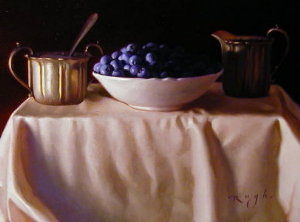
Oil Painting View a larger image. Blueberries and Cream, 9" x 12" - oil/panel

It's impossible to be impressed with oneself.

Whether I'm outdoors painting or in the studio people always say, "I wish I could paint." A few of us thought we could. We admired artwork that seemed beyond human ability and we sat down to draw and saw accidental moments where renderings came alive. Always reaching, if there were enough of those moments we continued, our head in our sketch pads, each time a special nuance revealing itself just beyond our capacity. The fact is you never arrive. Once an optical quality is mastered it no longer holds an unattainable mystique. Sure, it's satisfying to create with it but it's no longer, "I wish I could do that," because you can. And it's on to the next thing. Levels of mastery in painting are endless and as we develop our eye we become more efficient at reaching and enjoy more time inspired.

I've found the same principals work across disciplines: developing as a painter takes the same resourcefulness -- and a combination of mind and body -- as learning classical guitar or even playing a sport. There is an obvious hierarchy in local tennis: it's all here here. Unlike painting, at the end of the day you can win and bring a trophy home to your wife and say, "See!" A good match is when you play well just above your skill level but the guys that are there are reaching somewhere else. They don't want to play down and when you finally get to play them and do well you think well I guess they weren't as good as I thought they were. You don't notice the newcomer watching from the sidelines because you're busy reaching again. And like art there's always more to be discovered.

-Doug Rugh

Monday, May 07, 2007

Apprentice

Oil Painting Man, 8" x 5" - oil/panel

The goal is to disappear.


Then reappear.

The apprentice coddles the sable over raised brushstrokes (cursing away Style's tempts), corrects a skewed perspective and steps aside, humbly, in front of the seamless Illusion. Later he winces at overlooked edges and gasps at unsubtle hues. He turns away from a lopsided horizon to stare out the window. Defeated, he oils down the surface once last time for what he hopes will be a finer layer with all traces of the hand removed. He is channeling John Singleton Copley and Franz Hals hiccups. A thousand squints later and smears of pigment start to become forms disappearing into the ether.

At some point individuality returns as the peculiarities of creative brilliance replace the anonymity of technical mastery. The artist's idiosyncrasies and subjective taste manifest themselves in brushstrokes -- eloquent ticks -- and a body of work representing a personal vision rather than an affected style (still imitators miss the heart and focus on the cliche.) While alive we want the artist to get out of the way of the art. When gone it is traces of the personality that we want to see.

The musician sits for the lesson, wipes a bead of sweat from the brow, and searches for the intoxicating solos that reverberated off tiled walls so willingly at first light and finds instead awkward cadences squawking from his unchosen instrument: the unabashed crescendos now falling flat at his feet. The first public performance and he forgot to dress. Later the music will play itself.

The lilting off-time rhythms of the maestro improve on the metronome. Moving from perfect to bewitching.

-Doug Rugh

Friday, April 27, 2007

De-limbed Statues

When he said he'd come back tomorrow for the statues I knew what he meant. He absent-mindedly used the arborist's vernacular to describe the 15 foot high stumps now standing like monuments in the center of the yard. 95 foot high white pines 75 years old or more no longer hover over the roof. My first daughter was born 28 months ago the day of the Asian Tsunami and when we were all settled into the maternity ward I raced home through our own Cape blizzard to let the dog have a moment outside. The driveway was blocked with snow but also with a large limb from what we realize now was our favorite of the trees. The trees shed branches in storms and we are always the cause of tremendous fireworks as branches brush up against the high power line sending showers of sparks along the road. It usually ends in a pop! from the transformer as the neighborhood goes into blackout. This last storm we took our little girls elsewhere and let the neighbors watch the trees sway 20 in each direction as the worst hit just before daybreak.

At this moment, 20 feet in front of our picture window, our favorite stands proud as the same two squirrels spiral up it as they've done so many times before only to be surprised to reach the top so quickly. Now we have the sky but yesterday we still had the long reaching branches swinging in the wind and silhouetting the moon and we had all the activity that came with them: our own nature channel. A pair of cooper's hawks built a nest in one of the trees with a straight view to the row of bird feeders. At night we occasionally hear the spirited hoot of an owl up in our high canopy but through the day we have the melodic singing of so many birds and the staccato movement of various wood peckers as they hop along the straight shafts.

Yesterday as the tree surgeon cut his way up the tree he exposed a large squirrel nest and it reminded me of a time, sitting on a friend's porch, when we watched a squirrel move from the tree in front of us along the wire and up another tree farther away taking exactly the same route three times each with a little squirrel's tail hanging from her mouth. So my wife worried about the nest but I didn't. Shortly after the men left the squirrel appeared as expected with the little fluff hanging from her grip but arrived instead from the adjacent tree which the new family must have waited in during all the noise of chainsaws and heavy machinery. So now all the little ones are safe again. The waves of the tsunami are still being felt.

-Doug Rugh

Monday, April 23, 2007

Tickle and Hit the Road
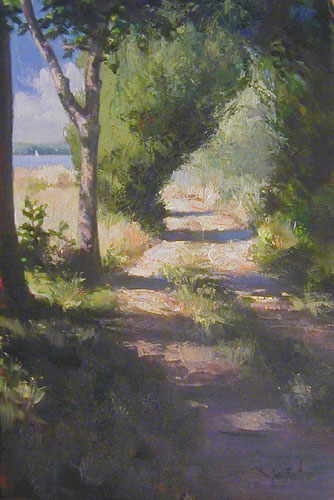
Oil Painting View a larger image. Road to the Beach, 18" x 12" - oil/canvas
This road leads to Alfie's beach, a few yards of coast bought with sculpture, and a summer gathering spot where artists sit around bonfires.

Thresholds are places of creativity which liberate the brain from its' rounded walls. Neither inside or out, these moments of potential sometimes bring joy and sometimes bring fear but always bring progress. I relish the time up in a plane where all the demands of a place just lived in, now only dots on a highway rushing to get home and relax, vaporize to make way for a lofty and fluffier perspective. The ideal is always just ahead, uncomplicated. It's the same with dawn and dusk -- temporary alleviations from the limitless blue dome and the figments of encroaching darkness -- that allows for a heightened rest. Or at least a pause between inhaling and exhaling.

And as the seasons change the painter of nature paces in front of the window stopping to stick his stockinged toe out a back door to measure the temperature. Is it time yet? Fresh canvases multiply in anticipation along with the beginnings of buds barely visible on close inspection (but absent at painting distance.) The models who inhabit the studio will change to an even tan -- their skin literally refusing to cooperate with the portrait artist -- and insist on gazing out the tiny window wishing for anything, perhaps a butterfly to flit by and rescue them to less-dim surroundings. The first reaches of sunlight illuminate coffee cups filled with walnut and linseed oil soaked calico rags littering the floor. Quiet time of research in the studio will be replaced by the welcome art enthusiast crowding out the clouds over the shoulder (one quiet the other trying to be) and their positive attitudes a reminder (Social skills! Social skills!) to quit cursing the wretched canvas every time it wins in the struggle to maintain its' lifeless nature. The artist is saved, through an act of grace for all his suffering be it good weather or foul, an allowance to jabber or mutter to Self provided the gesticulation is kept to a minimum. It's expected.

Art by definition is about avoiding the routine and constantly searching for fresh ways of seeing. By luck a Cape Cod artist is forced to make changes (and grow or deviate) bi-annually in and out and along with our two seasons: summer and not-summer. With my new attitude that arrived with our first balmy day I won't mention and refuse to rant about year-round indoor Cape Cod photo-copiers (the painters that is -- not the machines) and anyway the aforementioned doesn't apply to them.

So here we are again and many exciting plans for winter projects are only half-finished but we're on to new ideas for how to attack painting the summer that have appeared along with the realization that much of the hard work in the coming season entails sitting in a pretty place and paying special attention to it while the easily impressed look on. The best part, though, is when a dab goes on and it's just right and the whole canvas comes alive. Regardless of whether anyone sees it or not it's why we paint. And we keep tickling that perfect color, admiring it until it's gone. And then it's on to another.

-Doug Rugh

Monday, April 09, 2007

The Right Brain at Work and Play

Oil Painting View a larger image. Cloud Shadows, Back River, 30" x 48" - oil/canvas

In the off-season I work on large studio paintings that are based on studies done in the field. The plein air sketches are painted quickly (as the environment is changing) in a process of reacting to and mimicking what is arrayed ahead. Ironically, while the eye is darting back and forth between the palette and the subject there's no time to stop and look at the canvas. It feels like painting blind. If you ever pose for a group of portrait artists it will be immediately clear whose paintings are based on looking -- their eyes in a trance and mainly on you -- but many will have their heads in their Job Lot special (odd-size custom-only framable) canvas boards.

The knife and brush are used to create a variety of marks that represent textural and rhythmic attributes in the landscape. It would be impossible to paint each blade or each leaf so instead the artist translates the impression into a language reminiscent of the scene. Each aesthete represents elements with unique strokes no less peculiar than their right-brained utterances (as charged: guilty!) But the beauty in these studies is the honest immediacy and a palpable sense of being there on that day. Just like the owner of a Rembrandt who can feel the ghost of the master through his tactile handwork, paintings done on location -- even those poorly executed -- can transport outdoors where the wind tickles the chin or a whiff of a cloud flashes by.

Science Meets Art
The studio works start with this reportage and turn them into pictures. By nature of the studio process, the artist must get creative when refashioning the work into a larger composition. Personal preferences, or style, drive decision-making rather than a need to emulate the organic and atmospheric. It is the painting itself that is now studied and prodded and shaken and with the studio door closed in the wee hours of the morning: coaxed into life. It is a painting of a place where the artist wants to go.

-Doug Rugh

Friday, March 30, 2007

Chiaroscuro

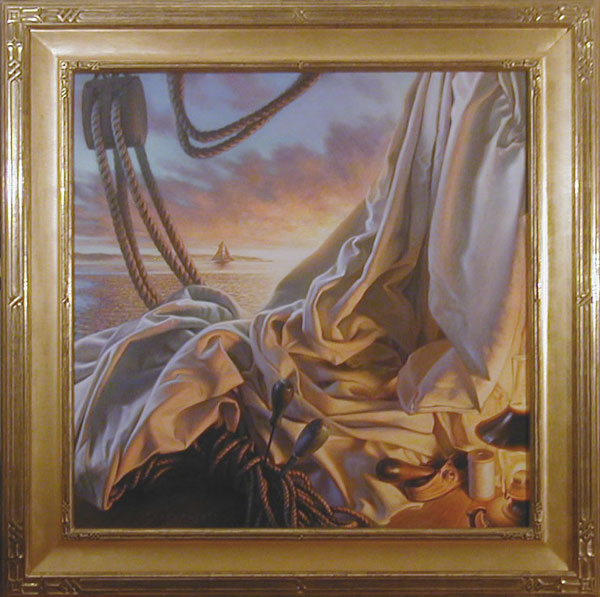
Oil Painting View a larger image. Mending The Sails, 35" x 35" - oil/canvas

This is a large still-life using sail maker's tools; the sewing palm, needle, awl and knife all illuminated by a lantern on deck. I try to let fabric fall as naturally as possible but there is always some adjustment necessary to get an interesting rhythm.

There is nothing more formally satisfying than painting white objects or cloth. A colorless chameleon, white takes on the colors of the environment and in a still life it becomes the temperature of the light that is directed towards or bounced at or enveloping the set up. I've always been interested in representing opposites: exterior through an interior; warm against cool; objects in space. On a philosophical level I get excited when paradox is the only answer to what appears incongruous so I was intrigued to find that the root words of chiaroscuro -- light lifting the tonal veil of darkness -- are both clear and obscure. Folds become beautiful when a little mystery (and shadow) is added.

The real challenge of this piece was not only portraying an interior and exterior at the same time -- something unmanipulated photographs can't do because of differing aperture settings -- but limiting both to the same type of light: in this case direct warm light in a diffused cool field. The illusion of brightness depends on the depths of the darkness it is contrasted with and in this case I was left only with dark accents and optical tricks for creating a sense of light. When I got to the sun and the lantern at lower right there wasn't much left in the pigment to draw from. What was left was halation, transparency (with opaque paint) and appearance of warmth in the folds. Since I chose to imply that the whole thing existed under a bright sky I filled what would have been darks with reflected blue light which, against the warm light, provided contrapuntal interest.

The yellow orange light at lower right in the ficticious background mimics the arrangement of light in the foreground: artificial/natural; direct/indirect; and hot/cold. I was pleased when someone asked (since they knew I didn't use photos) how I managed to set up the still life outside.

-Doug Rugh

Friday, March 23, 2007

Gone Postal

One day when I was a student at the Rhode Island School of Design I found a confusing card in my mailbox. Fitted through punched holes along the left side were varied thicknesses and lengths of natural looking yarns and neatly hand-written next to each sample was the color name. Words like: alfalfa sprouts, tofu, granola, spirulina, tahini. If something out of the ordinary happens at an art school the first assumption is that an art event is taking place but on the other hand I felt this was a personal message to me. Did I recognize any of the hues as colors that I might wear? The other students had a more current sense of couture and perhaps someone was trying to let me know that I was projecting the not-so-chic tones of the health-food store. It remained a conundrum until months later.

Another time someone was kind enough to leave a note with this advice written in small letters:

I was sitting next to you in class and I couldn't help noticing that your ears needed cleaning. Just thought you'd like to know.

A fresh Q-tip was taped to the card. I say kind because the note was unsigned allowing the Samaritan to give helpful guidance while avoiding the embarrassment of a whispered take-aside. I quietly slipped the Q-tip into my bag and walked out of the busy hall. Maybe it was the guy at the library's front desk who I mistakenly passed unshaven one day who put his hands on his hips and said, "There's such a thing as personal hygiene you know!"

It wasn't until later when I was sitting with some people in the textile department that someone described getting the same note with the Q-tip. The guy we were with said, "I put hundreds of those in people's boxes. I got bored sitting in the mail room all day." I realized instantly that the crunchy-granola color samples were probably just an old weaving project that he had done and rather than discarding his trash he could disseminate it and give it new life. Nobody gets letters anymore.

-Doug Rugh

Monday, March 19, 2007

Neither Then Nor Later
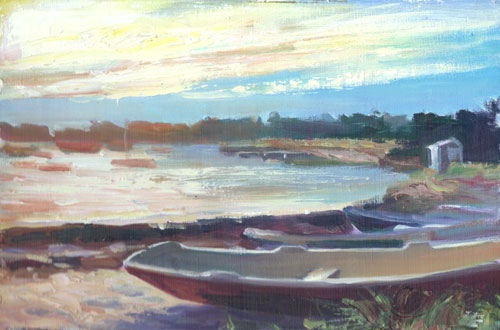
Oil Painting View a larger image. Dories, 6" x 9" - oil/panel

I always feel a productive restlessness when the sun lights the sky and need to keep busy working with my hands. And later there will be something about lambent stars and that hovering hole in the heavens that will stir the mind and quiet the body. But my favorite times of the day are the thresholds of dawn and dusk that free the thinking and the doing: a perfect place of art.

Late in the afternoon contented souls pass the Woods Hole Yacht Club along with the sun as it burns one last time behind Penzance Point. But not before leaning for a few moments with a home-made dory on the beach.

-Doug Rugh

Sunday, March 11, 2007

Man Overboard
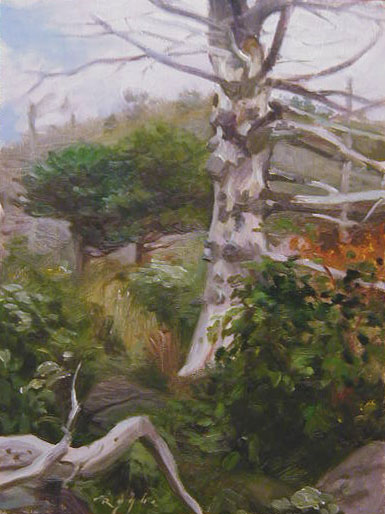
Oil Painting View a larger image. Whispering Pines (Monhegan Island), 8" x 10" - oil/panel

We were on Monhegan Island between the twin cliffs of Black Head and White Head down near the pounding surf working the rock when I did this painting. The winds, even though it was summer, blew a chill through our sweaters. There were wooden crosses at intervals way above the high tide line like the kind you would see adorned with flowers along the highway marking an ill-picked fate but these were coiled with a thin rope and a flotation ring. It was obvious that these life-savers would provide no match once the sea started its' tugging and I imagined the locals at meeting shrugging their shoulders -- some snickering -- as they voted for them. Hillary and I were finger-cropping in all directions trying to choose between interesting compositions (we only had a week!) when we spied our house-mate, the ever practical Herb Edwards, climbing up the side of the cliff. The plastic table that he had rigged up as a portable studio was strapped flat to his back and the aerodynamics of which was creating uplift making him look very much like one of those garage-made aviators as he hung to trees in his near vertical ascent. We were a little concerned.

I set up my gear in the bumpy brush amongst all this wild growth twisted and scarred by the wind and could feel the wallop of the surf in the earth through my boots. Minutes earlier near the water on a large rock with day-trippers we watched a foolish young kayaker hundreds of yards out who had disobeyed the signs warning boaters to stay away from this side of the island. When we heard cries of help Hillary and I both left our spots and met back at the rock. We could see through binoculars that he was now hanging on to the side of his kayak in his wet suit. Without hesitating one guy was off and running back for help even though it was a rough hike back up to the nearest house. Our cell phone didn't work. Another visitor, just arriving on the scene, got through to 9-1-1 and they said, "Isn't there anybody there on the island that can help you?" but they were transferred to somebody in town. The whole thing seemed futile and we all watched as he continued to cry for help. Someone was yelling, "We hear you. Hold on!" but he kept pleading. He was lucky -- if being stranded treading in frigid waters could be called lucky -- that he wasn't closer to shore where he would be sucked under and slapped up on the flat black rock. I had been told that the reason that side of the island was so dangerous is that there was so much air churned into the water that it was like quick sand: there was nothing to hold you up.

There was nothing we could do except watch the poor guy succumb and by now there were a half-dozen people at our location waiting for a tragedy. Hillary and I looked at each other and she said, "I'm going back to work." I laughed (how could she do that?) but we both did, checking every few minutes. Isn't this the point where the coast guard comes over the ledge in a helicopter or David Hasselhoff zips around on a jet ski? He had been out there 20 minutes or so when the double-decker mini-ferry (being diverted from its' course) came swerving through the currents and fished him and then his kayak out with a long pole from the top landing.

It was almost an hour later when we were back in town and word was making its' way around the village when I saw him go by in one of the trucks allowed on the island. I recognized him by the sheepish expression in his eyes. He was wrapped in a blanket and still shivering.

Later that day the guy that hit a golf ball through one of the windows in our rental told us that he received the call and arrived in his motor boat just moments after the ferry. He was also the carpenter that took care of the property and would fix the window and we saw him later working on the unloading crew that meets the boat. There might just be a dozen people running the whole island.

-Doug Rugh

Wednesday, March 07, 2007

Louise Don't Look At This
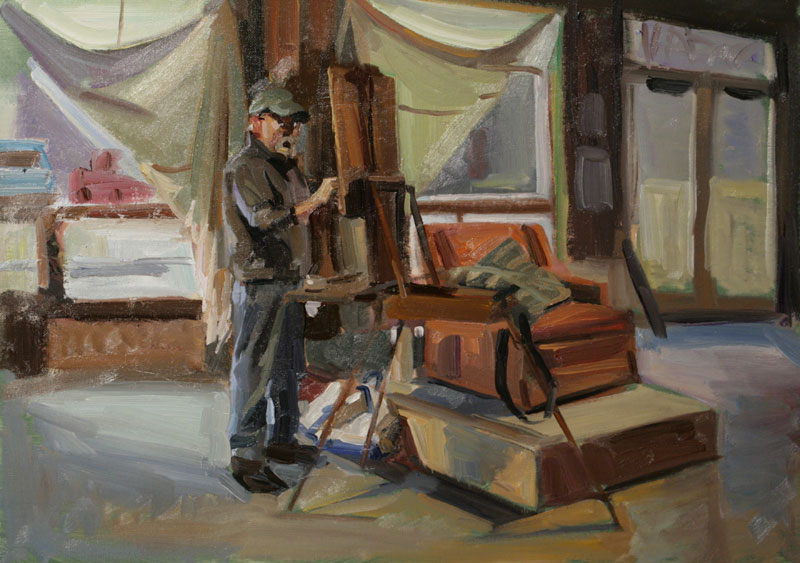
Oil Painting View a larger image. Plein Air Painter Indoors, 18" x 24" - oil/canvas panel

The model wasn't able to make it Friday to the Cotuit Arts Center figure painting session as sometimes happens when the weather is inconvenient. But Nick and Bob were there so we arranged ourselves in a triangle and painted each other. I had a mid-sized panel and could only count on an hour or so of overlapping patience -- if one of us stood back or threw his brushes on the floor our triad would be broken -- so I poured a little poppy oil in a palette cup to speed up the paint and leaned into the canvas.

The overcast sky and rain shed its' cool light on the concrete floor giving the interior light, by contrast, that characteristic orange glow at bottom center. The sheets that drape the window would normally be ablaze with hot sunlight but this day had a beautiful cool translucency which diffused the light as it entered the room. And normally our cooperative model would be draped across the chair improving its' appearance upon the platform. Part of the charm is in just painting what is there: setting up the easel, spinning around (as Sargent was said to have done) and making something from what you're given.

I enjoy painting something that is alive and moving. It's not just translating dabs of color from three-dimensions into two but understanding how something looks in the round even if it changes. If the second foot moves after you've painted the first its' position has to be adjusted in your mind to go along with the first. It's not a photograph -- an instant frozen -- but a friend at work, his feet alternating between steady and a step back. His arms flipping through the canvas bag on the floor looking for a rag or poised above the canvas. He's either engrossed in his work or (it sounds funny to say it) studying my legs, "Are you going to keep them like that?" he asks.

"Your wife's going to have to buy this painting," I respond.

"I know. Don't let her see it."

-Doug Rugh

Tuesday, March 06, 2007

King of the Nursing Home

Oil PaintingView a larger image. Keeper's View, 8" x 14" - oil/panel
Panorama seen from Nobska Lighthouse near where I play on grass courts each summer.

It just so happens that at the age of 43 I've got a head start on learning skills that most people wait until they are retired to begin to develop: painting pictures and playing tennis. By the time I get there I'm sure to be top dog at the nursing home.

I started playing doubles three years ago and got a kick out of it right away. It's the same experience as I have when painting. Both giving an exhilaration that comes from being in the zone -- from having skills but letting instinct take over. The game demands total concentration or you'll let your partner down and pushing color around can change form from almost-there to almost-hopeless if you don't keep on top of it. Hours have passed and you look up at the painting and say, "Wow. Did I paint that?" Or you find yourself in mid-air watching a ball spin perfectly away from an opponent's reach in a play you haven't attempted before and you think, "Wow. Did I do that?" Never mind that you lost the last set because all your "creative" shot-making didn't go as pictured. But it's the left side of the brain that cares whether you win or not or whether the painting was better two days ago.

Since I'm relatively new to the game I have new things to try each time I step out on the court. The element of creativity comes when the body intuitively senses a shot or a strategy to try at an instant of frozen movement. There is the complex physics of a ball arcing through space according to the swing that sent it, bouncing off in a direction dictated by it's spin and speed and court surface and struck with a racquet (with its own inherent physics-applying aspects) swung by a moving body who is not only thinking about the type of stroke to apply to the ball but where the three other players are and are likely to not be in the next fraction of a second. And then in the next moment the three-dimensional physics equation changes entirely. If you like thinking (and have good knees,) it's a great game.

While returning serve outdoors there's the added challenge of staying focused when an osprey passes overhead in front of a particularly beautiful formation of cumulus clouds.

-Doug Rugh

Thursday, March 01, 2007

Hospital Cove
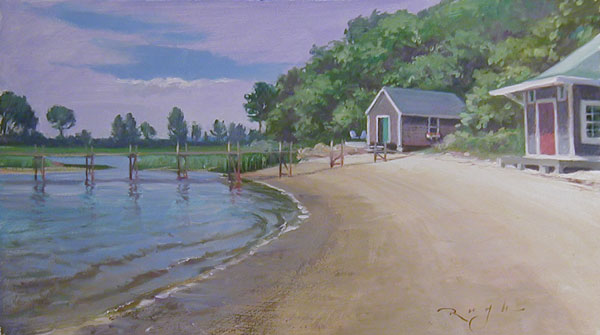
Oil Painting View a larger image. Hospital Cove, 8" x 14" - oil/panel

I was attracted to the way these two boathouses sat on the very edge of the land. A few inches prouder and they'd be overcome by tugging tides. We forget about the awesome power of tons of liquid sloshed around twice daily as the moon levels beaches like so much heavy equipment while we nap with the waves tickling our toes. I sat in the shade of the dock just out of view, following my rule to find a vantage point that was also a place that I would choose if I were stopping to enjoy the day.

One of the nice things about having a studio in Cataumet is that families have been vacationing here for generations and each place and each outbuilding becomes part of the history of the town. Things have to stay how they are because they've always been that way. While I was painting people came by and told me a little about the boathouses that line the cove (the far one has to have geraniums in the planter) and Itchigumi (spelling?) -- the marsh beyond -- which I assume is an Indian name but I'm sure some of the grandchildren think it is named after the itchies they get from wading in the water.

-Doug Rugh

Friday, February 23, 2007

Just Undo It
Oil Painting Lemon Twist (detail) - oil/panel

When I first got interested in graphics, pre-press was still done by hand but by the time I lived and worked in Boston everything was done on the computer: photo manipulation, illustration and page layout. I was given a drafting table with a fresh top and it sat unused in my cubby hole while I stared at a blinking monitor all day. It was an eight to five job which meant that to be among the first to arrive you had to be in before seven and to avoid leaving early you had to stay in until six or so. Unfortunately, what I remember now about the experience was the friendly banter masking what was really jockeying for position -- an environment I didn't feel comfortable in. I spent weekends on the Cape where I did what I missed most, working with my hands. I remember sitting outside carving an inscription in stone and being inspired by the handmade beauty of the letterforms that I had labored over in stark contrast to the flickering typography on my screen back at the office. But the one thing I missed most about the computer then and now is the undo command. Instinctively, as I carved a flourish a little too long my fingers searched for command + z to undo my last action. Instead, as in all things handmade the path is forward and a better state of the art becomes history. The flourish by necessity becomes even longer and more decorative; a mistake requiring a creative answer.

Almost all my paintings go through many different stages and some have three or four entirely different color schemes by the time they're done. I wish I could save each of the different states because there is often something I liked about each one. I end up stopping a quarter of my paintings at a place just after the one I should have gotten off at and those are the ones that are lost. Viewers see a single painting but I saw the movie of all the changes that were made. Art progresses in time but the slogan for the digital world should be just undo it.

-Doug Rugh

Tuesday, February 20, 2007

Simple Subject and a Visit with Nature
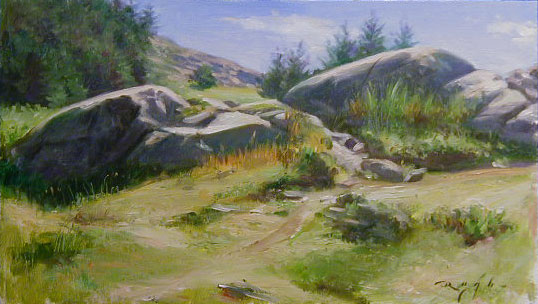
Oil Painting View a larger image. Cropping of Rocks at Lobster Cover, Monhegan Island, 5" x 7" - oil/panel

This oil painting was done on a painting trip to Monhegan Island. The island is small enough to travel by foot (vehicles are limited) and the variety of painting subjects -- the cut of cliffs along the rough edge, the small hamlet below the light house, the lumbering uninhabited isle framing its' harbor (complete with a legend about the hermit who once lived there), its' craggy path through deep woods enlivened by near invisible fairy houses built with organic debris -- have attracted a rich history of artists past and present. For one of my plein air panels I chose, instead, this humble subject within view of Jamie Wyeth's house which I recognized as the subject of many his paintings and which came to him through Rockwell Kent.

There is a logic in the way this subject is arrayed. The shapes of rocks breaching the surface reveal their geologic history and the degree the paths are well-worn, like jet trails in the sky, point to destinations of human interest or utility. What made me unpack my color kit was the unglamorous quality of the scene. This is one that couldn't be made up. It's too much of the unexpected: Nature is consistently anomalous.

On the ferry over from the mainland we were escorted by a pair of dolphins so when I heard the cry of "Whales!" by a day tourist I continued to work my brushes. My wife, sensing my skepticism, stopped painting and climbed over the rocks to my position to make sure I didn't miss the sighting. And there they were: two dorsal fins in unison rising and dipping slowly just off the rocks and close enough that I didn't have to get off my seat.

-Doug Rugh

Monday, February 19, 2007

Peace

Oil Painting View a larger image. Calm Harbor, 35" x 35" - oil/canvas

The square is perfection in stasis. Even a weighted composition doesn't disturb its inherent equilibrium.

-Doug Rugh

Sunday, February 11, 2007

Time to be Nice
View a larger image.

In Malcolm Gladwell's book The Tipping Point he cites the study in which seminarians were asked to write an impromptu speech, some of them about the Good Samaritan, and then walk over to the next building to deliver it to an audience. Along the way they passed a man, slumped and with eyes closed and coughing and groaning -- clearly in need of help. Some were told they were late and others were told they had a few minutes to spare. What is interesting is that the group that had the story of the Good Samaritan fresh in their mind were not at all more likely to stop. And most didn't. Some even stepped over the poor fellow in their haste to the next hall. The only group that stopped to help, 63% of those did, were the ones that had a few minutes to spare. Intuitively, I know this to be true: I'd be nicer too if I had a little extra time.

When I read about John Singer Sargent's portrait sessions I was surprised to find that they went on all day long and for days at a time. There are stories of women weeping after many hours of posing when the artist would grab his palette knife and scrape the whole thing down for a fresh start. It is surprising, at first, because of the quickness of the most obvious of his brushstrokes as they travel along forms. But when you study his paintings, looking past the flash of facile marks demanding attention, you see carefully rendered features blended by soft hands. It is hours of careful looking with a flourish at the end to make it look effortless.

His models also found the time to let the master entertain them at the piano. An era where there was more time than we have now perhaps partly because at the turn of the century the phone wasn't yet in wide use or, for that matter, attached to our belts. Imagine waiting for communication to arrive by post before being sent into action. (I had a roommate once that left his mail in a pile until Sunday to read because, "If people needed to talk to me right away, they'd call." But he didn't answer the phone either or the doorbell unless he was expecting somebody.) Where artists make the mistake in emulating Sargent is cramming his methods into our busy schedules. It's not just picking up a brush and (with photo in hand) knocking off a masterpiece as he would have us believe.

Hold on: email coming in.

-Doug Rugh

Saturday, February 10, 2007

Brushstrokes in Balance
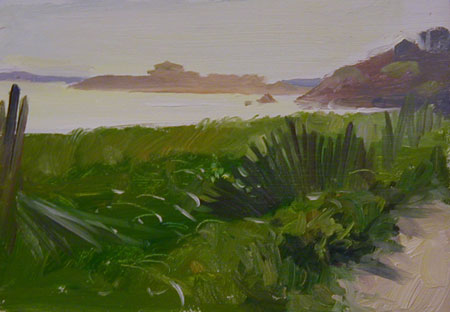
View a larger image. Airplane House, 5" x 7" - oil/panel

I was after the sheet of light that collected along the shore. This is one of those paintings that seem to paint themselves but in the end what I like most about this small sketch is the balance of brushstrokes. The panel is neither too fussed over nor overly stylized with self-conscious dabbing and the strokes that are used -- light catching on the grass, shadows at the lower right and silhouetted fencing -- are descriptive and lead the eye in a nice rhythm around the composition.

-Doug Rugh

Thursday, February 08, 2007

Embracing Museums

William Bouguereau - Nymphes et Satyre (Nymphs and Satyr) - Oil on canvas, 1873, 260 x 180 cm, Sterling and Francine Clark Art Institute, Williamstown, Massachusetts.

When I visit museums I like to go alone. There are many pros of being self-employed but the one negative is that the boss won't cut you a break and give you some time off. So, with the lack of dallying time and since I've already wasted precious painting time driving and parking, I walk quickly through each of the large rooms scanning the walls for anything of interest. When something strikes me I move in closer and take a little time with that work. And then it's off to the next room. In this way I can even visit everything in the Met in a day.

Museums and art books give something different each time they're visited. The same paintings are still there hanging in the same spots but there is something different about them and that something is how the viewer has changed. For me, it's what I'm thinking about these days. If I were to go today I'd probably just see bravura brushstrokes and take note of the size of figures and how they fit on canvases because that's what I'm thinking about (since I'm working on two life-size self-portraits.) Large paintings that I looked at from two feet away on the last visit, I'd now study from the middle of the room; and wonder how I could have missed so much. Size is misleading in spacious rooms where small paintings would cover half a wall back in my studio so I make sure to take measurements in my mind and relate the scale of compositions to my own.

There used to be a time for dallying in front of paintings and a girlfriend and I back in art school thought of a walk through a museum like most people think of a stroll through the park on a nice afternoon. Arm in arm and with plenty of time, it seemed that whoever got excited about a painting first got to enjoy it more. But I enjoyed seeing art through her eyes. One time I was gazing at a large painting and as I stepped backwards I absent-mindedly put my arm around her waist and she backed up with me but suddenly I was almost falling. When I looked at her face to see what was going on I found myself embracing a beautiful young woman that I'd never seen before. Luckily, she was amused by my error and, giddy and stunned, I quickly found the right girlfriend still standing in front of the last painting. I should have learned from my mistakes but a similar encounter with another stranger happened again later that hour. I suppose Freud might have said that my subconscious found a new way to meet girls but the truth is, like the hazards of cell-phone driving: my mind was elsewhere.

-Doug Rugh

Tuesday, February 06, 2007

Learning When to Pay Attention


It usually hits me when I come around a corner and see something unexpected or when a view suddenly appears framed through the trees; when colors don't yet make sense and I'm presented with a new way of seeing. The intrigue is in not yet knowing.

I did several interior paintings at the Briggs McDermott House in Bourne -- a historic home with a working blacksmith shop. I sat in a room upstairs tinted by the blue light through the windows and looked towards the bathroom wash basin and pitcher flooded with the yellow of direct sunlight. The difficulty was that the cool ambient light of the dark room that I was in colored my canvas as I worked and afterwards, back in the studio under more "normal light", I tried to adjust colors closer to how I really saw them.

I'm enjoying weekly figure painting sessions at the Cotuit Arts Center. Most would probably say the lighting isn't good because it's not controlled and direct but that's exactly what I'm trying to work with: unpredictable light effects. The model is silhouetted against a white cloth flooded with light when the sun is out but when it isn't blue, green and violet hues from the various windows throw their tints into flesh tones lit by orange spot lights (if they happen to reach near the model.) Dark green shadows turn orange against the backdrop when the sun comes out and direct sunlight moving across conrete floors throws warmth in unexpected places. The way most painting groups do it is to face a spotlight toward the model but walk around during the breaks and you'll see more interesting and more complex light effects on the artists as they rest their eyes.

-Doug Rugh

Thursday, January 25, 2007

Reverse Stealing

It's very easy to get your work into museums if you know how. An artist friend does it on a regular basis and explained to me how simple it is. We all have promotional post cards in our jacket pockets that have an image on one side and contact information on the other and he walks over to the card section of the gift shop and lays a stack of these cards down next to Picassos and Monets and Van Goghs. Artists are not like regular people who send a check in to the museum at tax time every year but rather have to find their own way to show support and my friend's way is to donate to the museum each time someone buys what would normally be a free card.

It's reverse stealing and I don't have the guts for it. I tried it once starting with a smaller museum and as I walked around the gift shop pretending to shop while I kept my eye on the staff and rotating visitors I felt so guilty that I was sure security had already been summoned by a buzzer hidden under a table. Perhaps the elderly woman inching her way towards me was really the in-house detective (surely another desirable job for retirees and volunteers.) There's only a few inches difference between a pocket and the goods and a hand moving back and forth between the two was, at the least, some sort of offense. I left quickly with my cards grateful that I hadn't been caught.

Reverse Reverse Stealing
Another friend, an actor, used to embrace the criminal aspect of shoplifting. In New York City as an acting exercise he would walk around a store looking as suspicious as possible until security would come over. They would accuse him of stealing and he would deny it all the while maintaining a defensive demeanor. One time he was chased down the street and tackled and he yelled, "I didn't take anything! Search me!"

-Doug Rugh

Tuesday, January 16, 2007

Sleeping Daughter
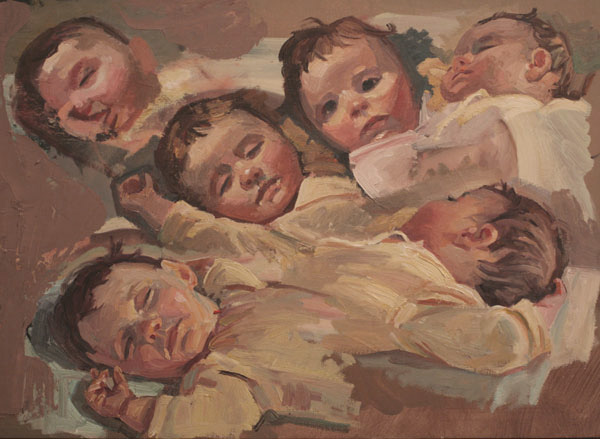
View a larger image.

I think it is very important for artists to work from life instead of photographs and this was brought home again as I painted these studies as my daughter slept. Not only is so much more seen with the eye but I want to be a painter of living things. It's a chance to experience the shifting cool hued light from the window play off her perfect skin. To watch blues and greens tint pale hollows before the forms turn under rosy cheeks. Color drains from her lids as she loses herself in sleep but in an instant she's ruddy-colored again and flipping her head back and forth. I paint the thumb back in again as she settles and, no....the palette knife comes out and I scrape the thumb out again -- oil is a fluid medium where images can easily be pushed around. Painted heads are what is left over from afternoon sessions spent watching perfect forms perfectly alive even in sleep. And now she's in a different pose and it's onto to a new sketch or back to an unfinished one close in posture. Then her eyes are open and I'm the one being watched. Years from now I'll enjoy pouring over photographs but for now I'll enjoy sitting with her when she sleeps -- the paintings an instant reminder.

I recognize hand signals that my infant daughter sends as she sleeps because my two-year-old used the same ones. Clutching and blanket-sucking signal a sensitivity to sound and foreshadow a fitful sleep but when my wife returns to top off the tired baby with a good nursing then she's knocked out flat on her back, hands open and arms stretched wide.

Baby Taco
In a bunting she called a baby taco, our maternity nurse could fold a cotton blanket perfectly around our new daughter. Flailing arms and legs remained tucked in tight, and with her thick black hair and olive skin our Eskimo baby slept contentedly in her cocoon. When we attempted to fold the wiggling limbs into the blanket our version of a human origami was so pitiful that the wrap needed more attention than the infant. As the baby got older, anything within reach was pulled up into her mouth and then we (thought we) had to worry that the blanket wouldn't allow her to breathe. If her bedroom seemed a little too quiet a welcome sight was the little girl out cold and arms up in the surrender posture.

-Doug Rugh

Monday, January 15, 2007

Break the Pickle
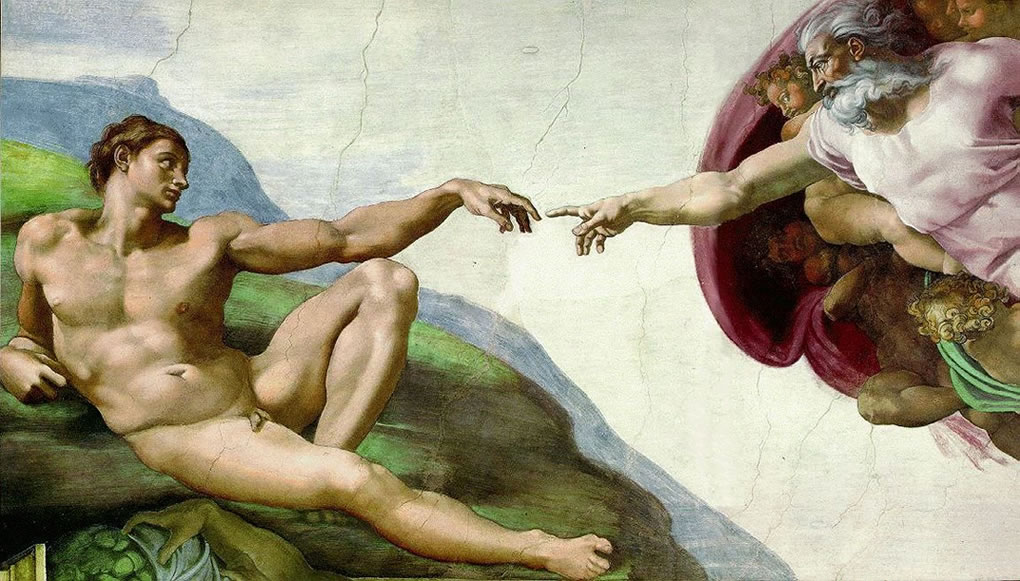
Creation of Man by Michelangelo

My two-year-old daughter doesn't like me to read her books. She just likes to talk about the pictures and she understood this one right away. Somewhere in her first two years she picked up knowledge of break the pickle. At times it is the little ones that teach us and I said, "Yes, that's right. That's break the pickle." We both stared at the picture, each of us trying to figure out who does the tickling. I was stumped so I tickled her and while she was distracted turned the page. That's pretty much how parenting works: if there's a gap in my knowledge I just create a diversion and hope the little girl sorts it all out later.

Later in the book we came across a man who had set a bad example: he had painted all over the walls. I didn't know how to justify the Sistine Chapel using her limited vocabulary so I just reminded her that we paint only on paper.

-Doug Rugh

Sunday, January 14, 2007

Oeuvre in a Box
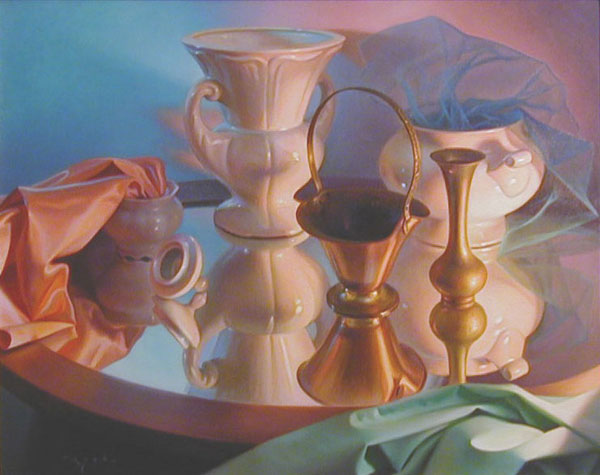
View a larger version.

Like many town dumps, in Bourne we have a swap shop where stuff that's a little better than trash can be left for a neighbor to use. Whenever I pass by I like to stop in to see what is there. It's a habit I developed from collecting props for still lifes. Summer Saturdays are when you can find the best stuff as people bring in boxes of leftovers from yard sales, each item still with a piece of tape marked 10 or 25 cents. If you are there when a car pulls up you get the first looks at the best bric-a-brac before it is picked over and can even learn something from the owner. I point to a large coffee maker which looks brand-new as a cleanly dressed man puts it on the shelf. "Does that work well?"

"It leaks a little bit," he replies and I move on.

Every now and then there is a box full of cheap frames and when I look closer I realize that, inevitably, it is the life's work of a Sunday painter. Cherished on the walls for one generation, saved in the attic for another until, in the process of tidying, someone has the nerve to move the oeuvre to a temporary resting place in a box beside a table at a yard sale in hopes of a resurrection. Maybe someone, another painter perhaps, lays out 50 cents for the only two frames that weren't split at the corners, and knocks out the paintings when they get home.

What the paintings lack in sophistication they make up for with heart. You remember the stories well as Grandma takes you on the tour (again) and shows you a painting of Harold, a cocker spaniel she had as a little girl. The head didn't come out right so she put a hat on him. For many painting is enjoyed as a pleasant pastime but some cling to the mythology of the artist and paint away in their basements waiting to be discovered. But, find out that they are a painter (there are people who live on your street who are as well) and they'll say, "Oh no, I couldn't show you them. They're no good."

-Doug Rugh

Wednesday, January 10, 2007

Painting Blind
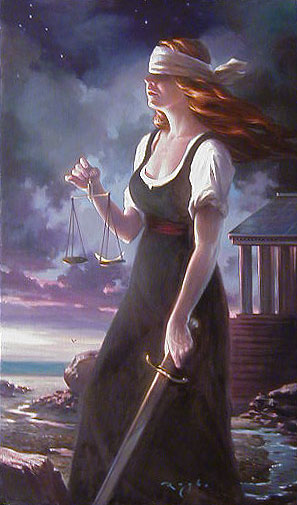
View a larger image of Blind Justice.

A few years ago I started experimenting with painting from the imagination. This piece was done for a show of allegorical works. It is different from anything else that I have done and is one of the first finished paintings that is completely made up. The details appeared as I tickled them out of a blurry fog. Going on instinct, I quickly pushed paint around until something started to appear. Da Vinci recommended staring at stains on the walls for inspiration and I just looked for the beginnings of details and pulled the rest from memory banks that have been filled by observation and time spent painting. We all know when something doesn't look right and this process was about continuing on in that search. Looking at the painting now -- since I've done a few more years of looking and studying Nature and paintings and people -- I'd love to go in and rework the whole thing but I would do that with any of my paintings every couple of years anyway.

I can picture an artist locked away in a cell working for many years on a single painting and each day remembering a little more. Maybe it's Rembrandt painting Saskia (she died after giving birth to their fourth child Titus, who Rembrandt outlived) where each retrieved memory shapes another highlight or turn of the cheek. Nothing is closer and farther away than our own thoughts and I've always believed that we can find answers hidden within our own mind. We become better painters not by reading How To books but by exploring and discovering through paint manipulation or other paintings. The more one knows the finer the insights. I'm always disappointed to find that students aren't able to grasp the best stuff I offer in workshops because they're not ready to hear it yet. These short classes always bring home the idea that if you can't teach yourself to paint you probably don't have the constitution to be an artist; at least in the sense that an artist is someone who finds new ways to see.

I try to always understand why effects in Nature appear the way they do and so I base formal technique on optical principals. One of the biggest challenges, especially in the landscape but also in the portrait, is allowing the unexpected to create a sense of the natural. It's a contradiction: controlled serendipity. Light a still life and every spot of color can be easily analyzed and understood but I often find myself outdoors surprised by an effect. Why isn't the ocean reflecting the sky like it should? Especially with clouds in the early evening: Shouldn't that cloud be lit up and where did it get that color? The confusion comes partly as a result of being a witness from within the set-up, within the atmosphere of the earth. A detail looks natural because it doesn't strictly adhere to rules of plasticity and this is the most difficult aspect to pull off.

I had a lot of fun painting the sky and the lower middle-ground and it got me excited about following my instincts. My hand moved and I watched as shape and space appeared in the form of a landscape that for unknown reasons was pleasing to my subconscious. Nowadays in the studio I do a lot of embellishment, even on paintings started on location, which gives a voice to the creative side of the brain. It's important to experiment because otherwise I wouldn't have found a whole new way of working that can be added to the process and best of all, a way for the artist's eye to enjoy itself. The best artists have learned to completely indulge themselves: a nearly impossible task.

-Doug Rugh

Monday, January 08, 2007

Color Study
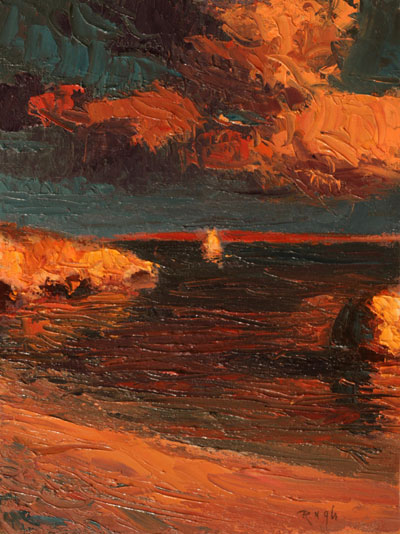
View a larger image.

Color can stand on its' own legs and have a bigger impact when left unencumbered by drawn details. I like to do these studies where I try to eliminate the impact of other painting elements in service of the specific one I'm working on. In this case pasting on thick paint with a palette knife not only gave me purer color than I could get with a brush (because of the transparency of oil) but kept the seductive power of finessed details from distracting from the color effect.

I visualized a place, in my mind, and started with an idea: A sailboat is a punched note caused by an orange sunset shining its' light just above the level of the water -- a dark foil -- against an almost complement: turquoise. I think that viewers generally respond first to color and then to composition and both of these factors are still important and, in fact, heightened in a palette knife color study. After that stylistic tastes diverge. Some prefer clarity and drawing (outlines.) Others appreciate serendipity and surface. A whole host of other aspects which can be followed individually like instruments in a symphony, become something entirely different as a whole, complicating the matter and insuring that painting remain an art and not a science.

-Doug Rugh

Sunday, January 07, 2007

Cape Cod Parent
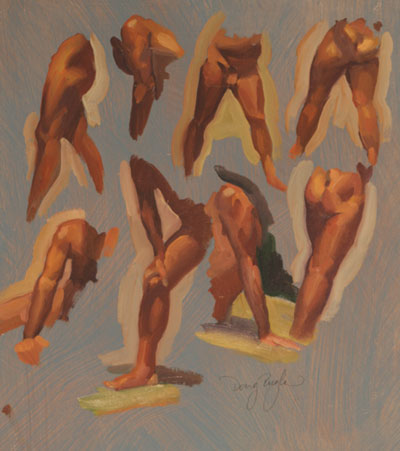
Figure studies - 12" x 9" - oil/panel.

My two-year old gets up just before dawn and we watch the sun rise through the trees behind the singing purple dinosaur. If I'm up a half hour or so before her I can write a little bit otherwise nothing for today or just a few sentences typed with one hand as she sits on my lap. After her banana we have a little breakfast. My wife comes out of the shadows and I'm off to the studio (the Cataumet Arts Center is just minutes down the road) with Chuckles for my half a day of play. I wonder how other fathers and mothers work regular jobs because I wouldn't want to be away from the kids for whole days and with commuting some are left only weekends for awake time with the family. Sometimes it's a tag team: hour for her in-between nursing a four-month-old, hour for me and so forth. Dilly-dallying time is eliminated. Add weekly figure-painting sessions at the Cotuit Arts Center and a portrait-painting session in Woods Hole with a group that calls themselves the Depressionists, tennis three times a week and down-time is left for the car on the way to do errands. I brought up the idea of joining a singing group and my wife just shook her head (end of subject.)

I keep hearing about successful writers and artists who only spend a long morning working. Skills need to be developed over years but perhaps inspiration time is better left to short bursts. Without children I wouldn't have tried working only part of the day but I'm now living the dream and enjoying it. I'm toying with the idea -- when the kids are off to school and more time is freed up -- of incorporating music into my afternoons. The lack of composing/playing being a regret I don't want to have. Then it's on to the mountain top.

-Doug Rugh

Friday, January 05, 2007

Cape Cod Artist
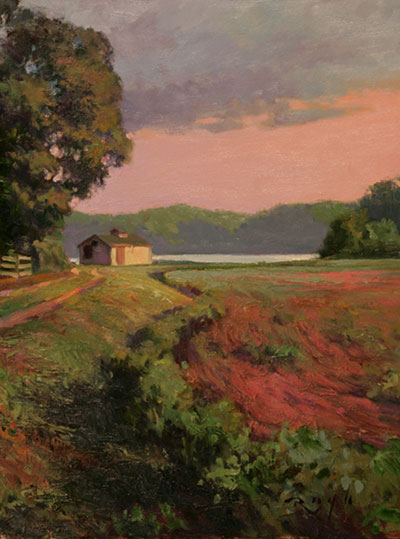
Bog at Dusk, 12" x 9", oil/panel.

One day this last summer I drove up the hill to Nobska lighthouse and parked next to a van and an easel displaying a quickly painted sketch of the lighthouse. It was obviously for sale. I guessed the artist to be in his late twenties and I hadn't seen him around before. I found out that he had come from one of the southern-most states and lived in his van packed tight with canvases. He had a laptop for communication and traveled around and painted, living off art sales. I asked how long he had been doing this and he said that this was the first day. It was then that I realized that it was his youth that I admired and not his guts. It's a good place to be, in a reality where the daydream hasn't quite cleared; a place of endless possibilities or life as a homeless person.

It was counterintuitive to find that the romantic idea of an artist's life is not conducive to a creative inner life which happens most readily, at least in my own case, when the rest of my life is secure and routine. To decide to be an artist is to accept being a second-class citizen. I realized this when I walked into a real estate office and was greeted with standing welcomes until I put "artist" on the informational form. Then the massage abruptly ended and I was ushered out. Where did all the smiling people go? I would advise a former assistant and aspiring young artist (I keep trying to talk him out of it.) when asked by a date what sort of work he is in to reply quickly and confidently (before changing the subject): corporate takeovers or, if he wants to stay honest; high-end wallpaper.

Making a living as an artist, however, is a rare accomplishment which entitles one to resume membership in the human race and I think it actually makes people happy knowing that some fantasies do come true for some people. One gallery owner talked about making me famous and I said, "Oh no, I don't care about that," before I realized he was talking marketing strategy and not vanity project. Because fame is part of the mythology, everyone's first reaction to a young artist is to say, "You're going to be famous one day." This is the chance for the student of facial anatomy to observe one of those complex expressions where admiration is mixed with pity. But it is relatively easy to become know locally out of default. An actor said once that the key to success was longevity. Stay in business while all the others drop out and assume the role of seasoned expert.

The biggest hurdle few can pass is affording to paint full-time. With a little talent (and lots of marketing or lots of talent and little marketing) and time to paint a semblance of a career can be put together. I've met many who were afraid to follow their bliss until after retirement hoping they don't end up like a friend's friend, waiting out the years for his pension to kick in only to die a week later.

I was surprised, also, that becoming a parent didn't cause me to quit my aspirations and become a selfless provider. Something about watching a childhood all over again helps remind me of what I thought life should be about. It's a world where kids grow up to use their personal talents and absorb their waking days in stimulating work. A sum-zero game where the level of risk is balanced with security. Sales = confidence. For a painter that means that the more paintings that find homes the more the artist's own personal expression reveals itself in the work and the more unique and valuable it becomes. Unwittingly, a collector increases the artist's value each time a piece is acquired.


-Doug Rugh

Wednesday, January 03, 2007

You, Too, Have Asked...
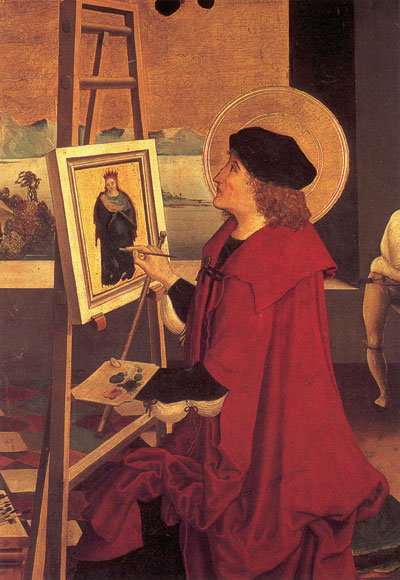
Saint Luke painting the Virgin by Niklaus Manuel Deutsch, 1515. Note mahl stick in hand.

You are being handed this card because you are in good company. Like 9 out of 10 men (and most women) who come up to me while I'm painting on location you have just asked, "What is the stick for?" It probably has something to do with the fact that it has a little ball at the end but I'm usually consumed with the task at hand and can offer no more than a short demonstration. "It's for steadying my painting hand," I say leaning the far end against the edge of the canvas. Now that I'm in the office dictating this tutorial to an administrative assistant I'm no longer distracted by rising tides and fickle weather, departing boats and changing colors or the complexities of paint manipulation and compositional design and can at last give you my full attention.

It was originally called a mahl stick (also spelled maulstick; from the Dutch maalstock "painter's stick", and from malen, "to paint") but our marketing people thought that the word had negative connotations and, frankly, it didn't test well. It may look like just a yard-long wooden dowel (we also make longer Tippytop Stick (TM) models for working on large paintings.) with a homemade padded ball at the tip to prevent the canvas from being poked but the one in my hand is just a prototype. You may ask, "Why couldn't I make my own Tiptop Stick (TM) by just wrapping, like you did, a piece of fabric from an old cotton t-shirt around cotton padding and rubber-banding it to the end of a cheap hardware store dowel? Or by gluing a rounded wooden ornament from a craft store onto one end? (Who doesn't have a leftover wooden egg or two in the attic?) Or couldn't I just pop a rubber doorstop tip on the end?" And I would readily agree that you could commit any of these acts. You could even take old collapsible tent bracing (the kind that is held together with an elastic inner string) and use it as a portable version of the Tiptop Stick (TM) and carry it in your pack. But each and every one of these hasty solutions would be a patent infringement, wouldn't they? I'm not saying that my team of lawyers would catch you and prosecute you to the fullest extent of the law but they'd try their damnest.

Let me guide you through the rich history of the Tiptop Stick (TM): Self-portraits by artists like Rembrandt always show the trusty staff in his hand. He was a poor artist who probably lived on soup made of boiled flax seed but he undoubtedly spent his last silver piece on a quality maalstock. The Mona Lisa (c. 1503-1507) was almost certainly painted with the aid of such a device and an expert tells me that Da Vinci periodically prodded the young woman with the stick just to keep her amused. I myself have resorted to a quick tap with the round edge in the studio when the model falls asleep in front of the heater -- the offense often goes undetected but will serve to awaken the model enough to resume proper position. But my dear friends it's mysterious origins are pre-historical and it is common knowledge that any cavemen worth his salt always had a stick in his hands. Those bison paintings wouldn't have been so sloppy if they had access to our Wielding the Tiptop Stick Guide (TM).

Tubed paints and Impressionist painting play a large role in the stick's banishment to the shadows in reproductions from art history books. Artists no longer need to steady the painting hand to paint detail and can slather on paint with the bravura of Zorro. After all, apprentices are not needed to grind the scant daily rations of select pigments into oil and artists can now waste colors to their heart's content. Painting detail sans-stick is risky but a measure of confidence can be obtained by steadying the working wrist with the free hand with the same posture a marksman uses in holding a pistol. But are you a soldier or a poet? Please read on.

It is likely that you will find, just as I have found, an application in your lives for this tool so let's avoid the delay while the product is in development (patent pending #12994883, ver. 3.9) and get right down to learning about the many benefits of the Tiptop Stick (TM). Most who ask about the stick assume it's a perspective tool and it is! By finding a vanishing point on the horizon the stick can be held along vanishing lines to approximate the height of figures near and far and the angle of architectural lines as they recede into the distance. By moving a finger along the length of the stick it can be used to measure relative units e.g.: the bush in the foreground is as wide as the mountain in the distance. Don't be caught sighting measurements on an extended thumb; that will engender ridicule and hushed whispers. Lest people forget: painting is a grave occupation and requires respectable gear.

But there is more. Traverse rugged terrain and the Tiptop Stick (TM) becomes a walking stick, the egg or padded ball fitting nicely into the palm. We've all been told over and over again that there are no straight lines in nature and though I will admit that the horizon curves ever so gradually there is nothing flatter than a typical composition's horizon line and -- low-and-behold -- the stick can be used as a straight-edge.

When painting in the bush inevitable tribes of vermin make their way through your protective clothing but -- what's that? -- why that's a back scratcher in your hand. When cutting across property to get to a favorite shoreside painting spot the occasional canine will nip at your heels but swish the stick through the air and the sound will send the pup reeling for cover.

It has only been in the last few decades that artist's have forsaken the use of this Third Hand (TM - pending ongoing litigation) and witness the coincidence with the decline of art. As Chairman-in-Chief I've advised the sales staff that our mission is not dollars but the elevation of souls. At $29.99 they'll jump off the shelves and surely enrich our stockholders (NYSE - TSTK) but our motivation is nobler: put the fine back in fine art!

Do you think in pictures? Well, then, let me paint a picture for you: The artist's gaze is intense; the rapture makes his hand tremble. He rests the fleshy part of his palm on the Tiptop Stick (TM) and with color on the tip of his brush he bears upon the smooth surface of the blank canvas spreading inspiration throughout the lands. All of this for only $29.99 at www.morethanjustastickwithaballattheend.com.

-Doug Rugh

Dear Gladys (Not Your Real Name)

When you call every Saturday because you don't know if the painting class is going to be held at 9:30 the next day I try not to be short when I say, "We meet at 10 AM, every Sunday except major holidays."

We have a game we play. I say, "Are these your keys?"

And you say, "I've never seen them in my life."

The next Sunday the keys are still on the counter. I say, "Here are your keys."

You say, "Thank you," and put them in your pocket.

Your husband says you're going senile because you can't remember things and then you say something that escapes me at the moment. Rick (not his real name either), then usually says that he likes getting older because he accidently rents the same video over and over but it's like watching a new movie each time. It's the same with the jokes we all tell; we help each other remember the punch line and then all have a good laugh. We're all forgetful or absent-minded but we still manage to get by. One trick I have is that if I find the box of cereal in the refrigerator I look in the cabinet for the milk.

Sometimes you come to the building but don't come inside. Maybe you're trying to remember why you would want to come in the first place. As I get older myself, I have less time to be charitable and I save all my patience for cleaning up after a toddler at home so it was with mixed feelings that I received your messages that you had both nominated me for a "hero" award and that the nomination wasn't accepted.

-Doug Rugh

Friday, December 29, 2006

One Thing in Life is Free
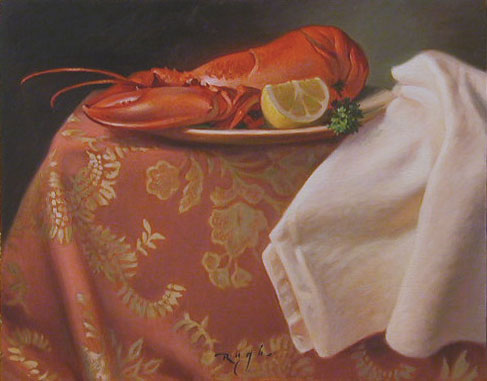
Sold at the Cape Museum of Fine Arts Auction. View a larger image. Sold at the Cape Museum of Fine Arts Gala Auction.

I visited Robert Frost's grave in Vermont where the inscription reads, "I had a lover's quarrel with the world." A sentiment that I'm sure is shared by other creative minds but first artists must pass through a tempestuous codependence with money. Fine art departments are filled with students attempting to avoid becoming a cog in the wheels of Commerce only to find out, after graduating, that they're sharing a studio apartment with her. (When I was first looking for apartments I asked to see what was described as an "in-room kitchenette." The landlord shamelessly opened a closet to reveal a hotplate on a small table.) The best way to avoid concerning oneself with what's best left to Caesar is to already have gobs of it. If that's not possible, let's hope that art students can find a way to make a living through the visual arts so they can get on with why they became artists in the first place, if they still remember.

For unknown reasons, anytime someone picks up a paint brush they lose all sense of self-worth. Hobbyists and skilled painters all are happy when their unpaid artwork is reproduced in print while career illustrators are paid appropriately for the same thing. Worthy charities regularly call artists for auction donations, often diluting market values, but who would come if we put on a gala in support of our favorite group of sufferers: local artists?

I know an artist (let's call him Rick) who will give you his work if you admire it and as a joke during one of our weekly practice portrait painting sessions I told the model to offer him $20 for the painting. He walked over and said, "That's a great painting. Would you take $20 for it?"

Rick said, "I'd probably talk you down to $15."

The model said, "Okay."

"But," Rick continued, "the signature is an extra $5." Needless to say, the subject of the painting took it unsigned. This willingness to please may be a common denominator amongst my artist friends because I had another one in college, a foreigner, who told me, "Any girl who likes me...I like her."

It must be tough to make a living as a novelist but if you want to partake of their work, just buy the book. Love to watch good acting? Buy a ticket to the theatre or rent a DVD. Like music? Buy a CD or a seat at a performance but if you enjoy looking at original art just walk into any gallery or studio: it's free!

-Doug Rugh

Monday, December 25, 2006

Loosee Leftee, Tightee Rightee
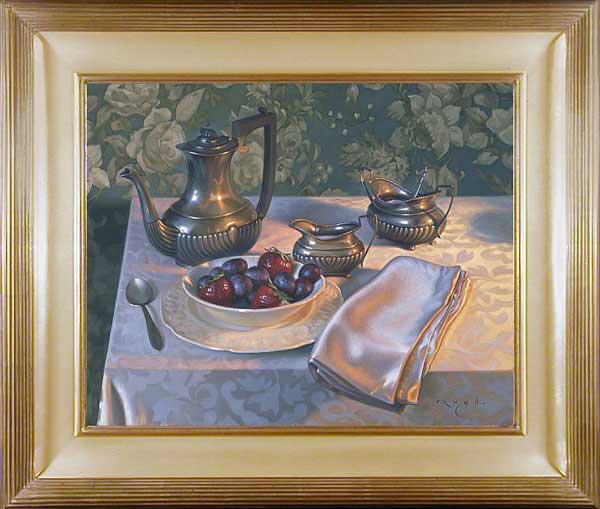
View a larger image.

There are two types of people that come in the studio. There is the loose group and the tight group and I distinguish them not by personality but by stylistic preference. I know which camp visitors fall into because I have both types of artwork in my studio and often a visitor will pick out the only tight one (or loose one) in a grouping and say, "I like this one." as if to say that I shouldn't bother with the other stuff (a little paranoia goes a long way.) Like the core members of the two political parties, our gut conviction falls one way or the other but I believe that if art doesn't enlighten it's due to the inadequacies of the viewer and the more we learn to look with an open mind the more we can get out of either type of painting.

I'm often asked which I prefer and I go back and forth. Technical differences often are just a matter of brush direction -- blending across forms or bravura strokes along forms -- and scale -- small and hidden or large and visible. Psychological differences are more profound and satisfy our changing needs throughout our lives. It's the difference between creating a window on a new reality with mastery or calling attention to the serendipitous virtuosity of the artist. A reverence for what is seen or an improvement upon it. Between the grave and the playful.

I've always tried to avoid having a style. Like personalities, they are best when they come naturally and are a by-product of an artist searching with a brush rather than a painter "branding" his product. It is impossible to make a mark on a two dimensional surface without it saying something about its' maker and as an artist strives to develop their work, it will naturally change along with their inner eye. The series of still-lifes I did a few years ago were very polished because I was focusing on optical effects that create illusions and the process was mostly about studying and seeing and hiding the hand of the artist. Now I often do sketches in which I intentionally avoid blending or fine brush control because I want just the color or the texture to do the work. If we did just what we did well over and over we wouldn't get anywhere and painting, to our great benefit, has a never-ending supply of places to go.

-Doug Rugh

Sunday, December 24, 2006

From Antiquity to Antique
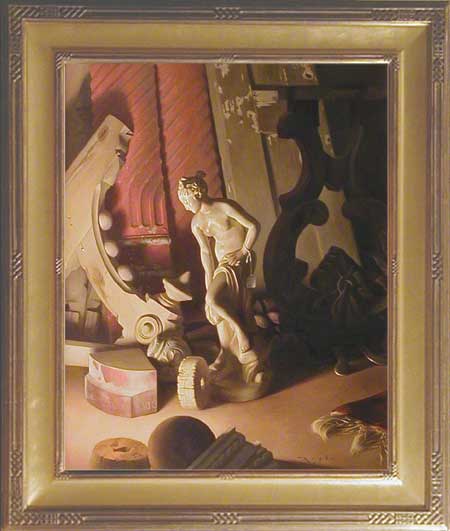
View a larger image.

There is a salvage yard in Wareham, MA that was the inspiration for this painting. Stacked up in this warehouse are all sorts of old architectural relics with carved elements that are beautiful in their simplicity. Part of the appeal lies in discovering these pieces that are tucked away in the shadows. I tried to convey the feeling of coming across these ordinary objects and yet seeing them in a special way -- with the history of art, architecture and music in the imagination.

The central figure is the muse among the ruins (though these scalloped columns are pink) and the carved organ pedals are in the shape of her lyre -- I especially like the way the light filters across its matte black surface. The quiet touches of light on the brass pedals lie at the edge of this vague shadow. The cork floats and the wooden balls stand in place like miniature stone monuments and the turnings behind the figure are intriguing and mysterious. The wedge-shaped base has the tooled number "333" representing the spiritual aspect of the artisan who balances the aesthetic with the pragmatic. I took great pleasure in painting the raking light as it worked its way across the tassels on the carpet as I considered one of my muses: Vermeer.

-Doug Rugh

Saturday, December 23, 2006

Sparking Psyche

View a larger image.

One morning, while I was attending the Schuler School in the mid-eighties, I woke from a dream in which I figured out a new method for drawing with accuracy from the portrait. There is nothing more satisfying than immersing oneself in a subject and an occasional gift dropping from the sky is a natural outcome of that. As a young art student I tried to learn as much as I could. It was partly out of fear -- I was aware that few students were able to go on and make a living as artists -- but it was mostly driven by the dearth of knowledge and the daily discoveries available to the novice. So when it came from the subconscious I knew there must be something to it.

A friend says the painting gods let you paint a good painting every once in a while when you're about to quit just to keep you plodding along but I always felt like there were, and still are, little moments of insight each day. In the dream I was sketching at the easel and I held up a ruler to transfer all the horizontal measurements of the head, at the size I saw it, directly onto the paper and then I put the paper directly below the head, from my vantage point, and transferred all the vertical lines. I had done something similar in a drafting class in high school where we transferred lines for a plan, side and top view of a simple object. It seemed so obvious why didn't artists know about this? I learned later that this was an adaptation of the sight-size method. I often use a practical application of this method (measuring with just my eye) when I paint small heads and tiny figures from life since I paint them at the size they appear from the distance I'm sitting at.

-Doug Rugh

Friday, December 22, 2006

Head in the Clouds
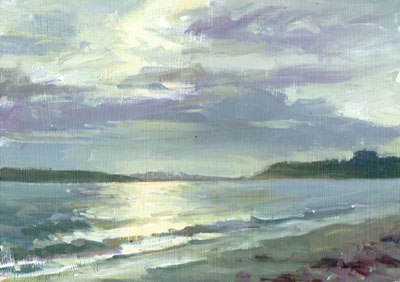
View a larger image.

I have a special fondness for paintings done on location because there's no better way to feel what it was like to be there. Their hurried sketchiness doesn't detract from the realism and it's a realism that photographs can't capture because they won't select, as a person can, for the salient features. Although, if you happen to be there and aren't paying attention you might miss the experience as well. Often the focus of what I'm after with these small 5" x 7" panels is to capture that time of day and a sense of the weather. Looking at the painting now I can feel the wind in my face as I looked into the light of the passing clouds and I remember not seeing the painting until I was done.

It usually happens, especially outdoors trying to capture a changing subject that includes clouds and water, that the artist has no time to look at his own painting and that may be why this little painting takes me back so clearly: because the process is about absorbing the mind in the subject and really looking and experiencing. When I was a kid I had a book called Zen of Seeing that was about achieving an experiential realism that was above and beyond pictorial realism and that's exactly what I'm talking about here only I hope to add an oil painter's and a picture-maker's knowledge as well.

It happens like this: What should I paint? Wow, look at the light in the clouds. Set up. Work quickly to capture the moving sky remembering what it was moments before and anticipating how it's going to become. Periodically survey the scene for unexpected events. Feel the wind on the left side of the face and then brush in the waves and then back into the clouds. The palette and hands move colors around automatically. Realize the sky is completely changed: stop. Stand back and see what happened. Just as a song or a smell can take me back to a long past memory, this painting will always take me back to that afternoon on the beach.

-Doug Rugh

Thursday, December 21, 2006

Painting Seasons

A woman came into the studio yesterday and said, "I can tell you love what you do." And she's right. My 15-year old mutt lies on his pad with his end against the portable heater and his back along the legs of my studio easel. I have to step over him to leave the room so he's got me penned in. I've got a cup of hot coffee and I'm singing along with the radio heedless of the bodies in the other room looking around the back gallery. I arrived early and have had plenty of concentrated time to work and even though I'm finishing up commissions for Christmas I still have time to experiment on other special projects (of dubious commercial value.)

I like the rhythms of the seasons and the balance between uninterrupted time for painting research and dialogue with an audience. The Winter is for sequestering in the studio and working up new large paintings (from location sketches) and experimenting on last years starts, the ones that haven't yet come to life. The Spring is for finishing up and framing groups of paintings and getting them out to galleries and the Summer is for getting outside, always among onlookers, to be reminded of the beauty of the landscape and gather new visual experiences. Summer folks returning to the Cape each year are generous with their praise and tourists are easily impressed on location encouraging me forward. (Sometimes it's too easy when I receive exclamations for standing behind a canvas splotched with random color before I've even started.) In the Fall there is time to slow down a little from daily plein air painting sessions and think about something totally new to experiment with. Throughout the year, weekly portrait and figure painting group sessions provide amusement through personalities a lot more interesting than my own (wink, wink.)

Fact is, if I'm not inspired or excited about what I'm doing I use that as a gauge to tell me that I'm going down the wrong road. I'm no longer embarrassed when someone asks what I do -- "I just paint little pictures." -- because I've got a good thing going.

-Doug Rugh

Wednesday, December 20, 2006

Small Heads
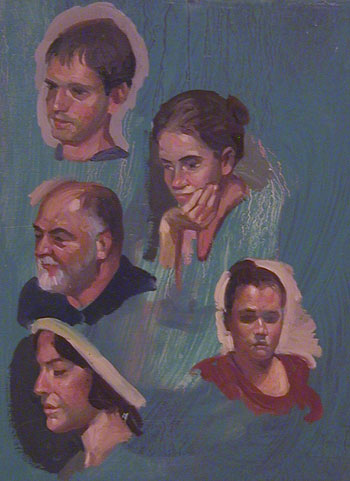

Each of these heads is about an inch high and was done in 20 minutes. When the model doesn't show up at one of our local portrait sessions we all take turns posing. It reminds us how hard it is to sit still for even short periods of time. It's also a chance to talk about the sitter without them butting in.

-Doug Rugh

Saturday, December 16, 2006

A Slow Slide Sideways
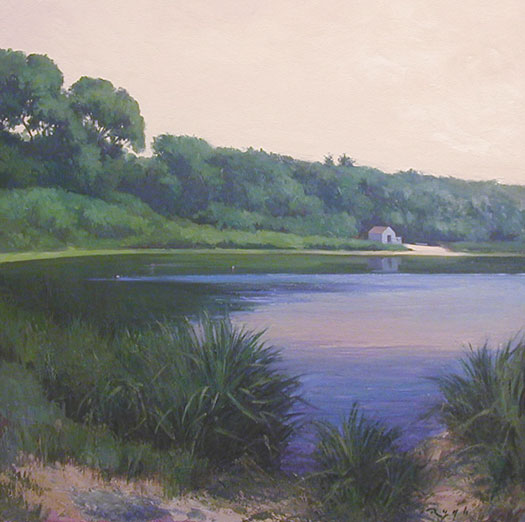
View a larger image.

There are two types of people. Those whose horizons sink to the right and those whose horizons sink to the left. I suppose the cause is due to many factors (not the least of which is a common astigmatism) including a slightly longer leg or the re-centering of the nose from too many years of preferring to sit on one side or the other of, first school classrooms and then later movie theatres and boardrooms. Our own personal off-kilter gravity weighs heavily and indiscriminately on either the left side of your brain or the right side of mine and may explain why you became a successful corporate raider and I chose the life of a humble painter. Can the explanation be so simple?

My world falls off to the right and when I first lay out my compositions they seem to drain down to the lower right corner. The element in my wife's painting all skew to the left. I have a level attached to my easel to help retrain my eye and at first it was disconcerting to look at a canvas that was truly square because I had to learn to paint cockeyed. It's obvious when I look at her compositional starts doubly exaggerated in contrast to my own but I've learned to no longer attempt to improve on another's sense of level. I once arrived at a house-sitting stint and immediately noticed all the paintings on the walls tilted in the same way. During my short stay there I did what any normal person would and adjusted them all straight. When the older woman returned she immediately nudged them all back, choosing to remain askew.

-Doug Rugh

Friday, December 15, 2006

Perpetuating a Might Have Been

It must have been twenty years ago that I read somewhere that someone was quoted as saying that Degas had said (it may have been another person quoting something a little different from someone else): "Orange lightens, green neutralized and violet darkens." As a young art student I thought I had found the "secret" in an old library book because when I experimented with the colors they worked but I quickly realized that Degas' way -- picture a horse race under a warm light complete with violet shadows against a green field -- was a great way but not the only way. He had a very sophisticated sense of color harmonies and what sounds like dogma was probably just an off-hand remark taken as gospel. Look at a book of his paintings and you'll see numerous different triads at work. Artists are often misinterpreted but it makes for good legends.

As artists we get to make our own rules and just by sticking to them turn them into law in the lands we create through our rectangular windows. It could just as well have been, "Green lightens, violet neutralizes and orange darkens." if an artist consistently uses those rules as I did when painting a dark figure with brown shadows and highlighted with a cool crisp winter light, all on a lavender gray panel.

Or was it a quote from Cezanne....?

-Doug Rugh

Wednesday, December 13, 2006

The Temperature of a Painting

View a larger image.

I usually have an idea I'm experimenting with and in Crimson and Violet I played with temperature changes. Compare the diffuse cool highlight in the shape of a window haloed by a blue aura on the left side of the tarnished teapot with the warm spotlight radiating light on the right and the light sources that effect every part of this painting become evident. Even every minute form in the tea set has to maintain the dual-color relationship with both colored highlights.

I love painting white surfaces because the reflective nature of white makes clearly visible the quality of light bouncing around the room. Take the bowl and plate and the range of colors from blue through orange and all the grays in-between. Notice the blue reflection from the window coloring the darks. Look how pure the orange in the shadow is on the right. Squint at the plate (to focus on the tonal values) and what you see is a simple light and shadow but open your eyes and see that the ornate patterning on the plate comes from temperature (warm and cool) changes rather than value changes.

The same effect is clear in the table cloth. Squint to see basic light or shadow falling on the table but open your eyes to see how temperature changes create the pattern. In this case the pattern reverses where sometimes the shapes become light and other times dark. Witness the silky tablecloth with its' diffuse but clear reflection of all the colors in the room complete with violet penumbras (a favorite optical effect and subject of a future posting) turning the forms.

The color and foreshortening in the spoon are a technical challenge (Mantegna shows how difficult it is) that is satisfying only if it is perfectly successful but the most pleasurable portion to paint was the strawberries and grapes -- rich warm and cool darks in a light field.

-Doug Rugh

Tuesday, December 12, 2006

Staring so Hard You Can't See
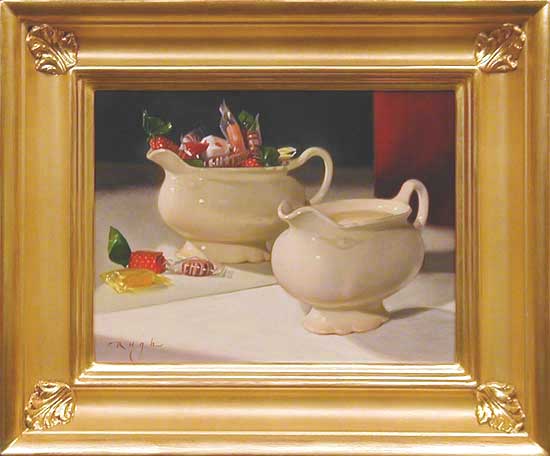
Magic Mirror by Doug Rugh View a larger image of "Magic Mirror."

It is easy to forget what is being painted when caught up in the act of rendering, and especially painting still lifes because the process is largely an act of studying and finessing. In this painting, Magic Mirror, the intention was that the mirror reflect wishful thinking but the concept could have happened unintentionally on its' own if I kept popping the candies in my mouth after painting them, working from left to right. It has happened to me before and it has happened to others. Florals with wilting and dead flowers or bowls of fruit complete with rot (Caravaggio did a famous one) may not have been intended as a vanitas allusion or even realized by the artist until pointed out by a fresh set of eyes. Ironically, slogging along in the process artists can be painting blind.

One time I was awakened from a deep afternoon nap by my loud apartment buzzer. I bolted out of bed, and confused by the fact that it was light out, opened the door. It was the only time I've ever had the sensation but in trying so hard to wake up and look I couldn't see for what seemed like a minute or two and stood there with my mouth open in front of an old high school friend who dropped by unexpectedly for a visit.

Many artist do one or the other but I have two distinct methods of working. The first involves studying Nature -- whether a head, or the landscape or objects -- and carefully rendering colors, outlines and textures. The time is spent accumulating a mental library of effects and gaining a knowledge of optical principals: the science of painting. The second chunk of time, and its' proportion keeps increasing, is the artistic aspect: Okay, it looks like the subject. Now how can I make a picture out of it? Just as a good actor plays a convincing role but a great actor brings a new life to the character I try to keep in mind that just making it look real is not enough.

It is amazing what liberties can be taken in service to the aesthetic without destroying the illusion. Winslow Homer painted green skies and got away with it. Michelangelo's heroic bodies had tick-sized heads. Rembrandt did hundreds of self-portraits and each one a different person. When I saw the actual Red House on Monhegan Island I realized that Andrew Wyeth's painting of it was largely pulled out of his imagination even though its' presence was very real. But we don't mind being fooled and I think, in fact, that it is those unreal parts that we most appreciate. It is usually the one thing in the painting that I'm going to change -- say a color or a too obvious brushstroke -- that gets a positive response. Often what we call beautiful is when we find something to be more visually stimulating than we expect it to be: when flowers are more brilliant than we remembered or when that winter scene is shades of maroons and blues rather than just a gray.

-Doug Rugh

Monday, December 11, 2006

By the Light of the Moon
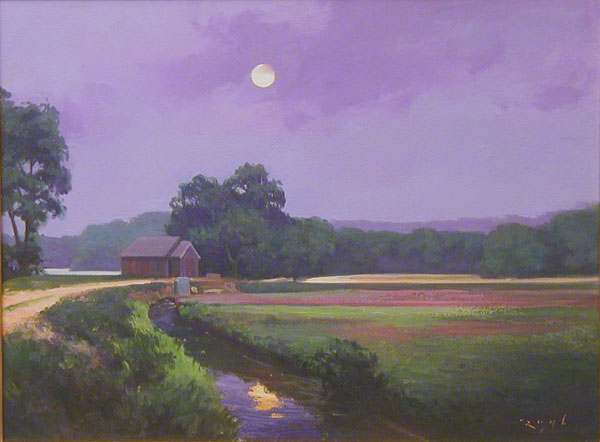
View a larger image.

On one of those perfect summer nights in Baltimore where walkers dawdle along the neighborhoods near Johns Hopkins University I came across someone with a telescope as big as a small cannon trained on the moon who was offering looks to people as they passed by. The size of a pizza, I could see craters and variations in terrain but the most awesome thing about it was the sense of this precise sphere, this big rock just hanging there in space. Just like in the old movies when the heroine gets that dreamy quality (from grease on the lens) the moon is just far enough away and out of focus so that romantics and poets aren't confronted with its geological presence. This junior astronomer then brought Jupiter into view and we could see one of its' four moons move in orbit. A short time after that and very tired but still thinking of the moon, I dropped into a bed in a room I wasn't accustomed to and I could feel the light of the full-moon on my face all night long. When I woke up I realized it was a street lamp out the window. An awareness that would certainly have ruined my peaceful sleep.

The best place to be under a full moon is near water. My favorite place is out in a rowboat on the ocean on a warm summer night. The oars are silent in the inky black sea and the sky can be as dramatic as a sunset and seem as colorful when the eyes adjust. When we're out at night my two-year old always looks for the moon and it has become an unconscious habit, but I suppose I do too. Maybe it is a primal awareness dating back to primitive times that causes us to notice it and perhaps many millions of people are soothed simultaneously by its' glow every night; like grounded moths drawn to a light.

Next time you find yourself looking at the moon ask your companion if they think they know where the sun is. Surprisingly, few people know given the hours in a lifetime spent gazing at the moon not noticing that it always points directly at the sun. Like a one-point lighting illustration in a book on how to draw, the sunlight hits the orb and the shadow falls on the opposite site -- easily confirmed when both rocks are above at the same time.

-Doug Rugh

Saturday, December 09, 2006

An Untoward Dalliance

"It would be exceedingly embarrassing, Holmes, if these facts were to become know. How can you be so sure of such an unseemly dalliance?"

"My dear Watson," replied his friend, "all the clues were there right before us and with minimal deduction any observer paying the slightest attention would find their reasoning completely synchronys with my own."

"Please explain," said Watson.

"Friday at dinner I noticed a most peculiar thing," the detective began. "Our acquaintance, with no attempt at concealment, placed three dinner rolls into his jacket pocket."

"Yes, I noticed that as well," interrupted Watson, "but it was an unconscious act and I'm don't believe we should go so far as to accuse the poor soul of theivery."

"It was precisely the habitual nature of the pocketing that completed my analysis and confirmed my conclusion," said Holmes.

"You mean...?"said Watson.

"Yes, I'm afraid to say our Mr. Rathbone is a living deception: he is not in mergers and acquisitions as he claims but simply an artist, and an outdoor painter at that."

"How can you be so sure?" asked Watson. He motioned to the chair, "Please sit and enlighten me."

Holmes lit his pipe and looked out the window. "The secreting of inconsequential foods is common among vocations of the self-employed variety -- those uncertain where the next meal comes from -- and the unconscious nature of his actions reveals many years as a habitual scavenger. But that is only one clue and there were many others."

"Please continue," said Watson.

"Did you ever notice, my dear Watson, that when speaking directly to the gentleman his eyes meet your own but he rarely is paying attention?"

"I suppose that's true. But how could he function in society and where is his mind at those moments?" asked Watson.

"The occasional smile and nodding of the head is all that is needed to pass as a contributing member of a civilized class but I dare say he was rather indulging his own eyes by studying highlights, shadows and penumbras whilst we spoke with him. And on our own faces!"

"Even if that were true how could you prove another man's thoughts?" asked Watson.

"It's purely circumstantial. But there is more. Did you notice that the thumb of his non-dominant arm was tan while the rest of his hand remained closer to pale?" asked the detective.

"I'm afraid I did not," said Watson.

"This is an affliction peculiar to the outdoor landscape painter where only the largest of the digits is exposed to sunlight as the hand holds the palette. This in itself would be enough to confront our "finance" man but there are other clues as well."

"Please," begged Watson.

"After saying good-bye I turned to watch the gentleman leave and noticed another blatant clue."

"Yes?" said Watson.

"From the front his coiffure seemed excessively pretty for a man of his pretensions, a fact I try not to make too much of, but from the back his hair was haphazardly butchered and obviously the work of his own hand. Even a man with dextrous hands has difficulty working the back of his head in reverse with a mirror."

"Interesting Holmes."

"And there is more," continued the detective. "During my conversation with the dinner guest I paid attention to the choice of words he used and discovered many of them to be part of a common dialect amongst this fringe sub-culture. Words like tone and highlight sprinkle his vocabulary and his knowledge of color runs deeper than the average wage-earner."

"Yes, yes," interrupted Watson. "He praised our hosts viridian and cerulean ensemble when I would have said green and blue. It now seems so obvious."

"But I found the most telling clue -- and I pity the fellow -- was when I surreptitiously dropped my napkin and bent down under the table to look at his shoes. There, arrayed across the topside of his footwear, were all the colors of the rainbow: an imprint of his palette of colors in reverse and each one he attempted to obliterate by repainting with shoe-color. A near perfect job," explained Holmes.

"The poor fool! And living right amongst us. What can be done?" exclaimed Watson.

"The passage of time cures all. Nothing need be done. If his conscience doesn't overwhelm him then the weight of ostracism will bring him back. As a matter of survival, in due time he will again be a productive member of society."

"I see," said Watson.

-Doug Rugh

Friday, December 08, 2006

The Color of Color

I'm interested in optical aspects of visual perception because it is an underutilized frontier waiting for discovery by technique driven artists. Often an artist's style is a pointed display of one or two of these phenomenon -- take John Asaro's saturated penumbras or George Innes' tonal works where he plays color off of a vague silhouette -- and it becomes obvious that there are many tricks available to express our ideas on canvas. A simple principle can become the underlying concept of even a body of work. Make everything blue and you have a blue period (I'm simplifying, of course.)

One of these ubiquitous but invisible aspects is viewing light. A big factor in how colors appear is the color and quantity of light upon the artwork but because of the relativity of colors -- under a orangish or bluish light the ball still remains red, the grass still green -- our brains are used to subtracting this pervading tint from what we see before us. Look at reproductions in your favorite art magazine under the daylight from the window or wait until later to see them under the bedside light and you see similar color relationships through different colors.

I created the above painting, Play of Light, under a different light than I expected it to be viewed under, on purpose. I used a bright warm floodlight to light the painting and when I took it afterward into more "normal" light all the colors became bluer -- giving me the maroon color in the cloth and the violet glazes on the ceramics that I was looking for -- and darker -- the mood I was after.

-Doug Rugh

Thursday, December 07, 2006

Lord of the Flies
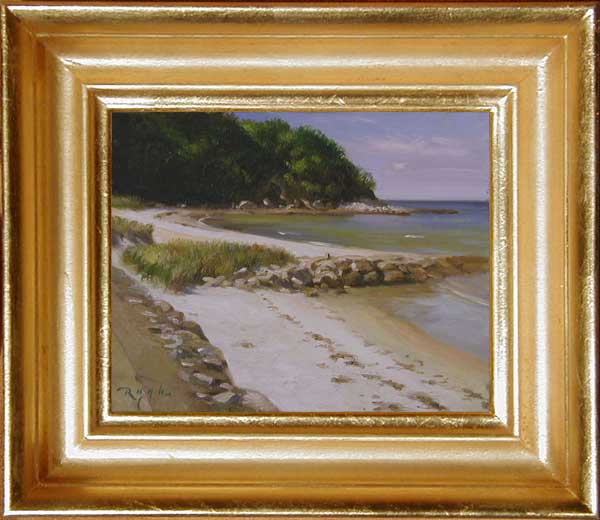
View a larger image.

When I'm working on location onlookers sidle up quietly behind me to take a look before speaking, perhaps to avoid the awkward position -- and anyone who's spent time around artists has been in it -- of having to discuss a painting that doesn't have any visible merits while holding the maker's ego in balance. But parents with children are different. They've just happened upon an opportune field trip, "Look at the artist!" And in a loud, clear voice, "He's painting. See the colors." They point at the palette but the little eyes just stare up at mine: they find it curious when the dummy in the diorama moves. I'm like any other parent now that I have kids but I wouldn't, as occasionally happens, stand my kids up next to the artist, step back and take a photo.

This little painting is of Old Silver Beach in North Falmouth, done on a quiet morning but when I decided to paint there one afternoon this summer it was filled with subjects. I backed my setup into the berm to discourage people from standing behind me and set to work. Painting people has a whole set of challenges when they are sitting motionless but since these were moving every few seconds, the session was sure to be a quick study of gestures resulting in the kind of mess that makes you want to lie down in the back seat of the car and hide. Soon a gang of boys was hanging off the rock wall behind me. I was painting their fathers, one of whom would ask me later to make him more muscular (as many men do) and one of the boys would run into the scene and sit hoping that I would paint him and then run back a minute later to see if I had, over and over again. Another was watching the wind blow the sand that he sieved through his fingers. I told him the sand was getting into the paint but he was having too much fun to stop. Could you have quit if you were that little boy? Another boy put his finger to the painting when he learned that the oil paint stayed wet. All of this would have been fine if the picture was coming along but it was too challenging and I was too distracted.

But I love it when kids come along. Little girls can be very supportive and I'm thankful for that. Very small children don't yet know the rules of the game. Painting atop the Knob at Quissett one day I was sitting low on a rock and a little crowd of kids come up the steps. Soon I had a little girl and boy leaning on the shoulders of both my palette arm and my working arm. They had no idea that I couldn't work like that and the two girls who stood right in front of me -- right in my view -- didn't need their parents to tell them to look at the artist.

Attention spans are short and children move on quickly. Now and then one wants to stay quietly and watch and I'm sure they're the ones that end up as artists. I was about 10 when I saw an older man painting at the Waterfront park in Woods Hole. I never talked to him. I just watched him for a while and then flew home on my bike to get my drawing stuff. I sat behind and a few paces to his right and began to draw. He wasn't friendly but I was content to draw next to him in my safari hat. The question is: does coming across artists influence us to become painters ourselves or is that a path that we are already on and merely a catalyst?

-Doug Rugh

Tuesday, December 05, 2006

Michelangelo at the Coffee Shop

Studies for Haman by Michelangelo.

About twenty years ago I saw a Michelangelo drawing displayed so you could see both sides of the small sheet of paper at once. I was stunned, not just by the beauty but also by the variety of marks he could make with orange conte (and these were small marks) and it gave me a lesson on how much description was possible through quality of line alone. In order to render form using just outline the artist had to touch the touch the topography of the body in his mind and hand while drawing. It's a sculptor's knowledge of what lies around the edge, a three-dimensional experience revealed on a flat plane, and the power to move the mind with nothing more than chalk and paper.

When I lived in Boston a friend and I would go to Harvard Square after work and sketch people that were just hanging out. It was contagious. It seemed that the more we did it the more other people started to do it. So, a few years ago when I went out to San Francisco for an exhibit I looked forward to having some time to sketch in coffee shops.

I like to leave anonymous drawings to be seen unexpectedly with a fresh mind and where art is best experienced, in the spiritual realm wholly apart from commerce. (I know money and art don't mix because whenever I attempt to leave the waiter a sketch on the back of the check as a tip whoever I'm with discourages the idea. This is how our community keeps us pure.) I found my coffee shop and after a long wait in line where each person had a whole list of things they wanted done to their coffee, I found a good vantage point and a paper placemat. With a pen I started to sketch a man reading beside his bowl of coffee. Something special comes out of work done when I suddenly change mediums or subjects. It is familiar ground but the fresh context awakens the creative spirit without the drag of too much objectivity: a chance to go along for the ride. I could feel people pause over my shoulder as they passed my table and awareness by my subjects as I tried not to look at them too directly. Someone nearby watched intently but the rule of the coffee shop, and why they're great for sketching, is you go to sit near strangers but you don't intrude on their privacy.

When I started to feel cramped from so much sitting I stopped to look at my drawing and was immediately pleased. It was reminiscent of all the Michelangelo's and Da Vinci's that I had studied with the hatching-in of transparent shadows and the nuanced forms overlapping each other. The ball-point showed great latitude, moving in and out from crisp dark to whisper-light lines and disappearing behind forms. Without signing the drawing I quickly walked out, leaving it on the table.

Part of the fun is imagining what happens to the artwork, much of it done on placemats. Does it end up hanging in the kitchen as I've found out later in restaurants? Or put in a cheap frame and hung in the bathroom? Was it the holy grail for the collector who is still looking for its' author? Or did it get crumpled up immediately and cleaned into the trash before he had a chance to see it?

-Doug Rugh

Monday, December 04, 2006

The Glooming
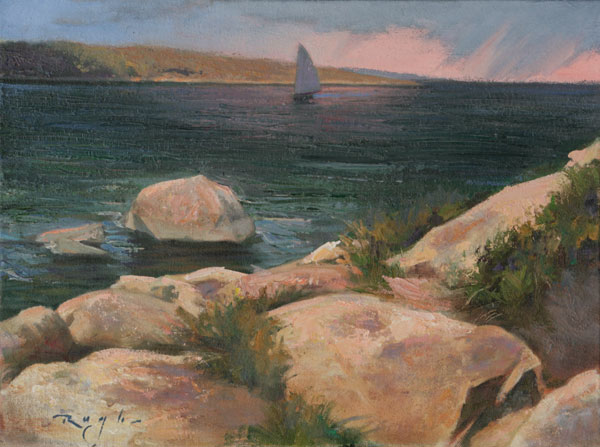
View a larger image.

More often it's the creative types that like dark artwork. Ironically, we feel most alive when we're struggling so the gloom in paintings has a comfortable seat within our soul. It's easy to get carried away and I try to bring myself back to a lighter world when I overhear someone outside my door say, "...he's in one of his moods. I wouldn't go in there." But with imperfect hearing I remember that I'm prone to imaginings and just continue along.

Occasionally, the message is clear. One time I was at the easel talking with a visitor and a guy comes into the studio and interrupts. He says, "I just have to say I love your painting out in the front gallery. It's incredible! Most people do pretty cranberry bogs and this one's different: it's death." I'm pretty sure that he meant it as a compliment but over the next few days decided to reexamine the work. I took what was then an image that included bare trees on an overcast day and added sunlight and the beginnings of Spring buds, all the while whistling as I worked.

-Doug Rugh

Friday, December 01, 2006

Color Mixing Secrets
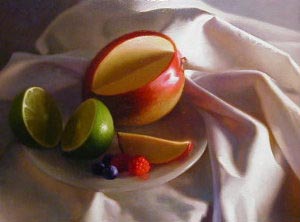
View a larger image.

I suppose few make the attempt to master color mixing because it seems complicated (aren't there millions of colors?) The subject has come up because someone asked about the colors I would choose for a limited palette. Since I'm on a self-imposed exile from the technical aspect of painting and because I've come to the conclusion that the only way to have a command of color-mixing is to discover it for yourself, I've tried to boil down everything I know about the science in the following principals (at the risk of appearing evasive):

Black and white are blue (I know this is a secret because I've never found it elsewhere.)
Add two and change three
The triad is the key
Light beats dirt
The dull cannot become pure again
A fluted column lacks unnecessary material (this is the response to the limited palette question of which there are many shapes)
The core shares axes
Complexity competes with purity
The vision is changed by the viewer
Switch domains and become contrary
Start with one and the rest follow
All according to the rules of proximity
And bound by the laws of gravity

I'd like to give a small framed oil sketch to the first person who can decipher these clues. Email me privately for confirmation.

-Doug Rugh

Thursday, November 30, 2006

Fog Induced
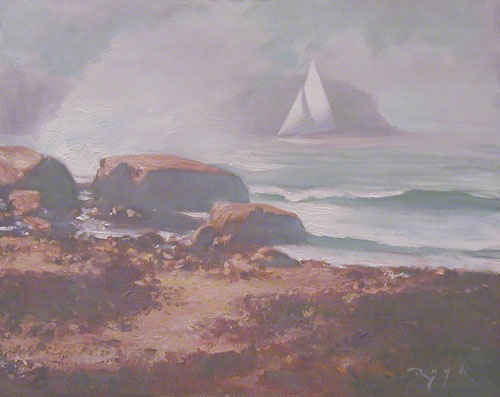
View a larger image.

It has been unusually warm for the time of year and with all the humidity in the air, last night we had one of those exceptional weather events characteristic of Cape Cod. It was after a tennis match and I found myself with an endorphin enhanced clarity of mind driving in the kind of fog where cars slow along the highway. As I entered a thick pocket the glow of the taillights immediately reminded me of the images that my engineer friend is collecting through his window with his homemade camera obscura. These soft moving pictures lit from the back on tracing vellum have the same hovering lights as the red stop lights on cars or the reflection of my own lights on bumpers -- pure beacons glowing in the diffused atmosphere.

Have you ever seen shadows in the air? Streetlights behind trees cast their limbs across thick fog like projected holograms and remind me of warm summer nights walking around a Woods Hole (add boat and fog horns for effect) transformed into an overblended monochromatic underpainting.

On nights like these you notice, for the first time, the variety of lights as they color the surrounding air, glowing like bowls and oranges in paintings by David Leffel and his followers. The radiating circles of light emphasize their differences and no longer just appear white. There are yellow and blue street lights, blue, orange, yellow and reddish lights on buildings and signs: polka dots of intersecting color realized by Van Gogh on his absinthe-induced nights.

-Doug Rugh

Wednesday, November 29, 2006

Baby Laps

There is a lot of adjustment when first becomming a parent. I keep trying to find ways to get stuff done while still having quality time with my child.

From a journal when my daughter was nine months old:

L.'s been walking for 3 weeks and does laps around the room pulling toys out of the chest as she passes, falling over things and needing things and then wanting to come up on the couch. Once up then going down. When she gets to my end of the couch, while stepping around my knees she sticks her hands in quickly and rat-at-tat-tat fires off a scramble of letters on my laptop. Invariably a help program or something I didn’t even know was downloaded on my laptop pops up. I gently push her arm away and control-z to bring my last few sentences back. Then she’s off and I can type until her counter-clockwise circles cross my path again and it’s the same thing all over again: see her coming out of the corner of my eye, type quicker, arm out to block and then undo.

Now, where was I?

-Doug Rugh

Final Rigging

View the larger painting.

An excerpt from a chapter by the artist in Still-Life in Oils, edited by Theodora Philcox:

I first saw this model boat when visiting the collection at the Massachusetts Maritime Academy and was struck by its home-made character. Right away, it brought to mind the model-maker carefully completing his special project. I imagined him indoors under a warm light and yet dreaming about adventures on the high seas. As an artist I also spend much of my time indoors working on my projects and before I know it I realize time has passed and I've been absorbed in another world. This painting represents the inner world of the imagination of the craftsperson.

The main thrust of the composition was created by arranging the light values in animated patterns. Though stationary, the boat seems to forge steadily ahead against the surging waves of the sailcloth. The dynamic shape of the cloth holds the excitement of the waves upon the sea. The light falls across the front of the sails and then ripples towards the stern in a rhythmic movement echoed in the repetition of the charts (or are they model plans?) to the folds of the sailcloth on the table, and then back up through the rigging and the forward sails. The movement ends with a quiet crescendo of the wave, not noticed at first, in part of a painting by Winslow Homer called 'Weatherbeaten' on the wall behind. Light bounces against the shiny surface of the bow as it slides through the 'water' and the silhouette of the raincoat on the chair continues the movement of the trailing wake that follows behind.

Moving on from the brightly lit areas of the painting the darker values operate on a secondary level representing the more mysterious and unknown aspects of adventure. The backlit diamond shapes in the chair become eyes in a world in which objects take on a life of their own. The framed picture becomes the fantasy of the boat or the artisan, and at the right all is seen of Homer's signature is 'mer' (for the sea.) The ornate gold frame represents the ideals of our dreams and as a compositional device allows the eye to move out and back into the painting. In the lower right corner are the 'real world' objects that the model-maker uses in his craft bringing the painting into contemporary times. This area works as a still life in its own right.

Since this is a large piece I tried to organize the composition so that it would hold up on a small scale because the painting can be viewed from a distance. At the same time on close inspection the picture will have details that provide new surprises. The ornate frame, for example, on close examination becomes a patchwork of abstract shapes that locks in to the representational illusion from farther away.

- Doug Rugh

Monday, November 27, 2006

John Singer Sargent's Palette

I think it was at the Peabody museum a few years back when I saw Sargent's palette exhibited. I was both disturbed and enlightened by the vision. I can tolerate drawers of tubes, their half closed lids over gooey paint and I no longer notice scraped paint clinging to the rug under my easel or the spots of color that, like a virus spread by proximity, pepper my clothes and my car but an uncleaned palette is unnerving.

The perfect palette is an improvement on the arm. I've made a dozen of them at different sizes. Perfectly weighted, it's beautiful irregular shape (designed for need and wearer) is the best example I know which exemplifies form following function. Balanced diagonally across the forearm, the top half is arrayed with nuts of paint, the lower half nestled in the crook of the arm, its' sweeping shape keeps the folds (of or) on the torso at bay. The rounded edge of the thumb hole is cut through the wood at an angle and its elliptical shape must be aligned at a tangent natural to the axis of balance of the reach of the individual artist. The wood must be durable and thin and light and I have come to prefer a flexible fine grain Luan plywood that I carefully sand to fit the clutching hand. The mahogany pores are filled and varnished and over time the daily whisper-thin glazes of oil rubbed into the center leave the surface hard and glassy: a stratus of color and a history of painting.

At the end of the painting session muddied paint is cut from the pure colors left around the edge and the center of the palette is buffed clean. The sheen is admired and then it is set below on the foot rest of the easel where the paint will be kept cooler away from the room's heat as it rises. In an emergency I'd leave my brushes filled with paint and scattered on the floor but I'd take a moment to clean my board so I was deeply troubled to see Sargent treat his so recklessly: an obvious and insurmountable break in their relationship. Cut a big X in the middle of The Daughters of Edward Darley Boit with an exacto knife and a conservator will make it disappear but let paint dry in the center of the palette and the rest of your days as an artist your eyes will go from blemish to inspiration to blemish to canvas over and over again until saved by death. Surely ranking low in one of Dante's levels of hell.

But I was inspired by John Singer's colors. Just shades with only hints of color; refined nuance and all that he needed for modeling flesh tones. Out of all the paintings I studied that day, those drab mixtures remain most vivid in my mind. Obviously, a lesson I was looking to learn.

-Doug Rugh

Saturday, November 25, 2006

Complexity of Quiet
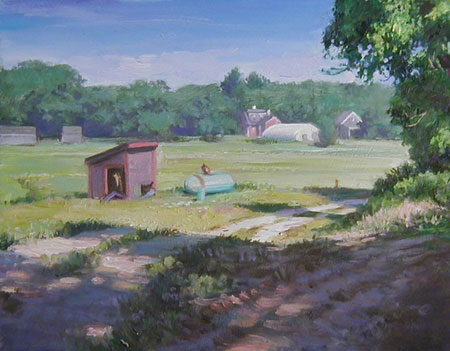
View a larger image.

Besides the cranberry pickers in-season the only people I see on these bogs are other dog-walkers. It's surprising how many bogs there are here on the Cape. Drive down a dirt driveway in the woods, as I have, and you may find yourself circling around one. And that one may lead to another or even a third or fourth. Like passing through the looking glass from vacation homes to farmland it is one of those rare spots in the height of the summer season where it's always solitary.

I think art satisfies a need. For most art collectors -- with their complicated and busy lives -- there seems to be an appeal in simple and peaceful compositions but my attraction to complexity in painting is a need for an engaging subject. One hectic summer day I found myself on this quiet road in Cataumet studying how sunlight and shade falls on a sandy and a dirt road and on the various grasses and weeds. As always on Cape Cod bogs, there is a sense of atmosphere as the moisture fills the air in these wide open bowls but the main reason I picked this spot was the challenge of painting fresh truck tracks in the dirt. An indulgence with what I am sure is solitary appeal.

-Doug Rugh

Friday, November 24, 2006

Turkey Day
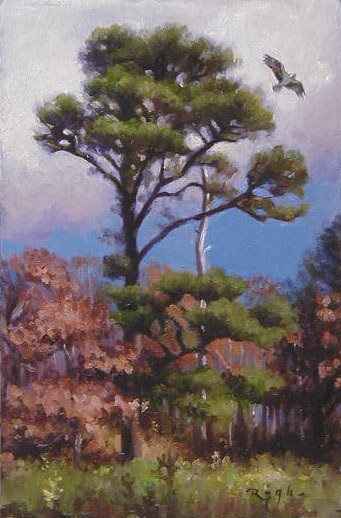
View a larger image. 9" x 6" - oil/panel

We found it auspicious that two Cooper's Hawks took up residence in a nest high up in the White Pines outside our bedroom window shortly before we found out Hillary was pregnant for the first time. And for the first time in his 12 years, our dog Chuckles had just stopped sleeping in the bedroom with us. We later listened to others' stories about their pets uncanny forecasting of an addition to their broods.

This is the tree where we had a secret marriage ceremony and it's the same spot where she asked the justice of the peace if the word "obey" was still in the vows. A short time later I remembered that I had done this painting. That same morning of our elopement we woke to find two turkeys also outside our bedroom window and looked up the omen in a book of American Indian mythology while denying ourselves a more colloquial and humorous interpretation. We knew it was significant because we had seen turkeys only twice before, and always on Thanksgiving.

A couple of days ago as the sky was starting to turn dark I was standing at the beginning of the path down to that same Leery conservation property in Monument Beach watching my daughter drop sticks in the creek and run to the other side of the little bridge to wait for them to float by. Suddenly, a flurry of feathers darted by our heads. Perhaps it was a hawk or even an owl -- it happened so quickly -- but I got a glimpse of a small red bird up front zig-zagging through the thicket.

-Doug Rugh